I was not there for the Slaughter of the Innocents. I was with the rest of the cast in the lounge that served as a green room—sitting on a comfy chair or on the floor with my legs stretched out in front of me. Doing homework, studying for exams. Chatting, singing Bob Dylan or Joni Mitchell songs if someone thought to bring a guitar. Hanging out with the other actors, waiting for our scenes to come up in rehearsal—
And gobbling down the peppermint patties that Jane brought to every rehearsal. As soon as she walked in, reached into her oversized tote, and pulled out the silver and blue bag, the atmosphere in the lounge visibly brightened. It was a simple gesture, nothing earth-shattering—but while I’ve forgotten many of the names of others, I’ve never forgotten Jane.
In December 1971, the University of Richmond’s theatrical production was The Wakefield Mystery Cycle, a medieval cycle of plays based on scenes from the Bible. Traveling troupes of actors in the Middle Ages would move from town to town, giving performances in village squares. Sometimes they performed the entire cycle of 32 plays, a marathon that took several days to complete. For our purposes, however, since we had a few hours, not days—and since we were coming up on Christmas—the director chose the scenes surrounding the birth of the Christ-child. One of these was the Slaughter of the Innocents.
I was in the middle of my first semester in college. Cast as an angel, I was to announce the coming of the Christ-child to the aging prophets Simeon and Anna. It was my first speaking part, eight lines of metered verse.
The Slaughter of the Innocents was the scene that directly preceded mine. One night when we were still in rehearsals, I slipped into the dark theater to see it. The actors were in fine form. Onstage, soldiers stalked and charged at mothers who clutched infants close to their hearts. Emboldened by their orders from King Herod to slay every male child under the age of two, they leaned into the women, leering at them—visibly proud of their power, the fear they inspired, the license they carried from the king. They ripped the bundles from the mothers’ desperate arms and speared them where they lay on the stage.
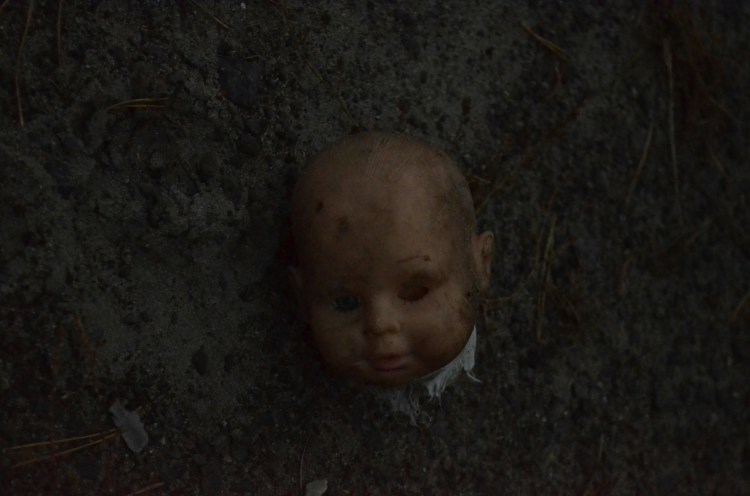
It was only a play, of course. Those bundles were nothing more than rough cloth, with maybe a doll tucked inside. But when the women screamed, the sound slammed against the back wall where I stood, barricaded behind rows of empty seats.
In the scene that followed, Simeon and Anna stood on the front edge of the stage, lamenting that they might not live long enough to see God’s promised Messiah. In the middle of their musings, I appeared behind them at the top of a 30-foot platform, standing on a small square and draped in a heavy white robe edged with gold brocade. I assumed a pose copied from medieval paintings and urged them to hasten to the manger:
There shall he be,
God's son before thee
     Whom thou yearned for so....
Thou hast desired it most of all.
My lines were the closing lines of our play, words whose purpose was to make sense of the slaughter of innocent children, to give it meaning, to rescue us from brutality, and raise us to a level of divine sublimity.
It was a tall order, and I took it seriously.
I wanted to do more than say the words, I wanted to embody them. Every night before I went on, I knelt down in a small dark room backstage, my knees on cold linoleum, my elbows supported by a plastic chair, and prayed over them—as if my few lines could shift the balance of horror in the world, if only I could deliver them right.
I was onstage all of about five minutes, as my organ professor pointed out when I used rehearsals as an excuse for not having practiced my Bach and Buxtehude.
My dorm was a short walk from the music and theater building. Tall antique lamps, giving the impression of gaslight, lined walkways of interlocking bricks that criss-crossed the wide green.
North Court, where I lived, had been built in 1914. The style was Collegiate Gothic. We made our way to our classes along passageways that mimicked medieval cloisters. The dorm entrance was a pointed archway. Once inside, I climbed stone stairs, smooth-worn under decades of trudging feet, to the second floor and down the hall to my room.
For my first year away from home, I deliberately chose a college far enough away to preclude weekend visits. I wanted to get as far away as possible—not because home was so bad, but because I wanted to escape anything that reminded me of my upbringing in the Southern Baptist church. I was disillusioned with the church. I have had it with those narrow-minded assholes, I thought. I’d spent all my young life trying to be a good girl, trying to live up to what I thought they were teaching me, only to find that, when the time came to stand up and be counted, they didn’t believe a word of it. I wanted nothing more to do with them.
And yet, the college I chose was a staid Baptist-run institution. The entire university radiated pride in tradition and heritage. At a time when other colleges were experimenting with coed dorms, our dorms were same-sex only. And female students were required to keep an 11 p.m. curfew. We had to punch a time clock when we left the building in the evenings and again when we returned. Of course, it was no problem to enlist the help of a sympathetic friend to punch our time cards for us and leave an out-of-the-way door slightly ajar—not so much as one might notice at a glance—so that we could sneak in after hours.
The roommate I had been assigned was, to my surprise, the daughter of the university’s new president. She smoked cigarettes with sophistication, as though she had been smoking for years. And she loved to stay out late and party—I was often the one punching in her card and leaving the door open for her to slip back in.
I do not think the university was ready for the freshman class of the fall of 1971. I do not think they were ready for me.
My first project when I arrived at University of Richmond was to become a hippie. I wanted to be a hippie in the worst way. I let my long hair go wild, instead of sleeping in rollers every night as I had in high school. I bought low-slung bell-bottom jeans and a plaid flannel work shirt from the Army-Navy Surplus Store. Those jeans practically never left my body. By the time I got around to washing them, they were stiff with sweat and stink and could easily have stood on their own. I’m surprised anyone could stand to be anywhere near me.
My other project was to learn how to drink. Nowadays it may be hard to believe, but I had never touched alcohol before I got to college. I—and the girl who lived across the hall from me—convinced an upperclassman in the theater department to buy us “the biggest bottle of the strongest thing you can find.” He obliged by showing up with a quart bottle of grain alcohol, 190-proof.
I don’t know about my friend Julie, but I was on a mission. I wanted to get good and drunk for only one reason: to know what it felt like, so that if I drank in public “with the big kids,” as I thought of it, I wouldn’t look like an amateur and make a fool of myself. The idea was that, having gotten drunk first on my own in the privacy of the dorm, in public I would feel myself going too far and stop. (Spoiler alert: It never worked.)
Julie mixed a yummy fruit punch, and we put on some Joni Mitchell records and started drinking. Two-thirds of the bottle later, I came out of what I would one day learn was called a blackout. The room was dark, and my roommate was asleep, while I stood in the middle of the floor sobbing. In my right hand was a rolled-up newspaper that was on fire. I held it in front of me like a torch. As I watched the flame crawling down the paper toward my fist, I had a moment of clarity: I’m in trouble. If I hold on to this paper, I’m in trouble, and if I let go of this paper, I’m in trouble.
While I struggled to clear my mind, the door to my dorm room swung open. In the doorway was a girl. Backlit by the hall light, her blonde hair encircled her head like a halo. And she was wearing grey cowboy boots. She yanked the torch out of my hand, threw it to the floor, and stomped out the flame—which is why I remember the boots. I remember nothing else.
I never did find out who she was. Many years later, a friend suggested, “Maybe she was an angel?”
The next morning I hung my head over the white toilet bowl in a stall in the bathroom that served the entire hall. I felt like I’d been poisoned. I had been poisoned, grain alcohol is no joke. In a daze, my eyes traced the tiny black and white tiles on the floor, arranged in squares—or was it interlocking circles?—while I prayed to vomit.
Sick as I felt, I could not make myself throw up. Even as a sick child, I rarely threw up, because I hated to vomit. But that morning, I stood up from the toilet bowl with a sense of pride. Good! I thought. At least I’m not a sloppy drunk. Heartened by this new-found knowledge, I stumbled out of the dorm and over the green to the rehearsal.
The night I had chosen for my first drunk was the night before tech rehearsal—a rookie mistake. That afternoon I had to stand at the top of the 30-foot platform while technicians angled the lights and changed the gels. My 5-minute scene stretched into 20 minutes, 40 minutes, then an hour. Smothered under that heavy white robe, in hot glaring lights and waves of heat rising from the stage, I swayed, a woozy angel, sweating and shaking, praying not to pass out and fall from my heavenly perch.
I made a mental note: Never ever get drunk again until after rehearsals or performances.
Oh, and never—ever, EVER!—drink grain alcohol.
I was not there for the slaughter of the innocents. I was 18 and filled with the promise of things to come, of days to be filled with living, of a future whose end was somewhere over there, beyond the limit of my sight. Looking back, it seems to me that I myself was something of an innocent—not only by age or choice, but by mandate. As a white girl, my innocence was enforced and reinforced by written laws and unwritten societal norms. What retrieved me from the threat of slaughter was an accident of birth, the color of my skin, and privilege I did not, could not, recognize.
Far from the cloistered environment of my college, there was war raging in the jungles of Vietnam. In an award-winning photo from 1972, Vietnamese children, one of them a naked girl, are running away from billowing clouds of napalm, their arms lifted away from scorched bodies, faces twisted in terror—while the soldiers behind them look off to the side, light a cigarette, or gaze emptily across a field. Only one soldier dares to look directly into the camera’s eye.
Closer to home were the photos of four little girls who died when a bomb planted in the basement of their church exploded while they made their way from Sunday School to the worship service. The nightly news broadcast film of children marching for civil rights and being targeted the same as adults, by firehoses and police attack dogs.
Modern-day innocents.
Now, toddlers are being ripped from their homes and placed in detention. They are used as bait to tempt their immigrant families to come outside where masked thugs can grab them. Most of these people have committed no crime. They are targeted for being immigrants whose skin is brown or Black. And in other parts of the world, in Gaza, in Ukraine, the bombs and bullets make no distinction between military personnel and innocent children.
The slaughter of innocents—and innocence—goes on.
I was not there for the Slaughter of the Innocents. My lines in the Wakefield Mystery Cycle were written to come after, to reassure and comfort. But in the face of such horror, what good are metered rhymes delivered from the top of a platform 30 feet in the air.
And anyway, who am I to hand out pearls of holy wisdom. Perched at such a remote distance, what the hell do I know of the brutality that stalks their children. I can play an angel on the stage, but I can never be one. As a friend of mine puts it, I’m “just another bozo on the bus.” To pretend to be anything else is an invitation to insanity—or my next drunk.
But, thankfully, I am not called to be an angel. What I am called to be is present. To show up, to be of service, a mortal among other mortals. To mourn with those who mourn. To dance (yes, to dance!) with those who dance. My calling is to be part of the community around me.
And the only way for me to show up for the innocents is to let go of innocence, both real and imagined. I gotta leave the lofty platform behind. I am called to do more than share a word of remote comfort. I am called to witness and work with others against the onslaught.
Doesn’t sound very poetic, does it. Well, good! Because this is the only way for me to live fully the life I am given.
And in the middle of the work, maybe it wouldn’t hurt to bring along a bag of peppermint patties. Something that affirms joy and connectedness. Something to share that says, I see you. Here, take a breath. Something to remind us that the horror in front of us is not all there is.

 holy discomfort: Love letters from a reluctant Christian