La Vigia: a story of Cuba
A poet and an artist walk into a bar.
Not a promising beginning to a story—particularly when you consider the time and place.
The beginning of this story takes place in Cuba during what Fidel Castro called “the Special Period in the Time of Peace.”
In the late 1980s and early 1990s, as the Iron Curtain collapsed and communism in the Soviet Union was being disassembled like the Berlin Wall, Cuba found itself without the financial support they had depended on to survive the active hostility of their neighbor to the North.
I was told by Cuban friends who lived through the Special Period that the shelves at local grocery stores were bare. Electrical blackouts were a weekly, even daily occurrence, some accidental, some planned to conserve energy. Musician friends scheduled recording sessions around them, sometimes working in the middle of the night.
Others told me the story of a particular Christmas Eve, or Noche de Paz. One person brought an egg; another, a tomato. Others scrounged together whatever they could find, and with the jumble of ingredients, they made an omelet. They divided it between the people who were there. The portions were small, but that didn’t matter. Sharing a meal together was the point. And then they sang and danced.
So, against this backdrop, let’s begin the story again.
A poet and an artist, living in Cuba during the Special Period when no one had enough of anything necessary to sustain life, walk into a bar. Or a coffee shop. Or maybe the house of a friend, where they drink cafe mezclado, coffee ground together with chicharo (beans).
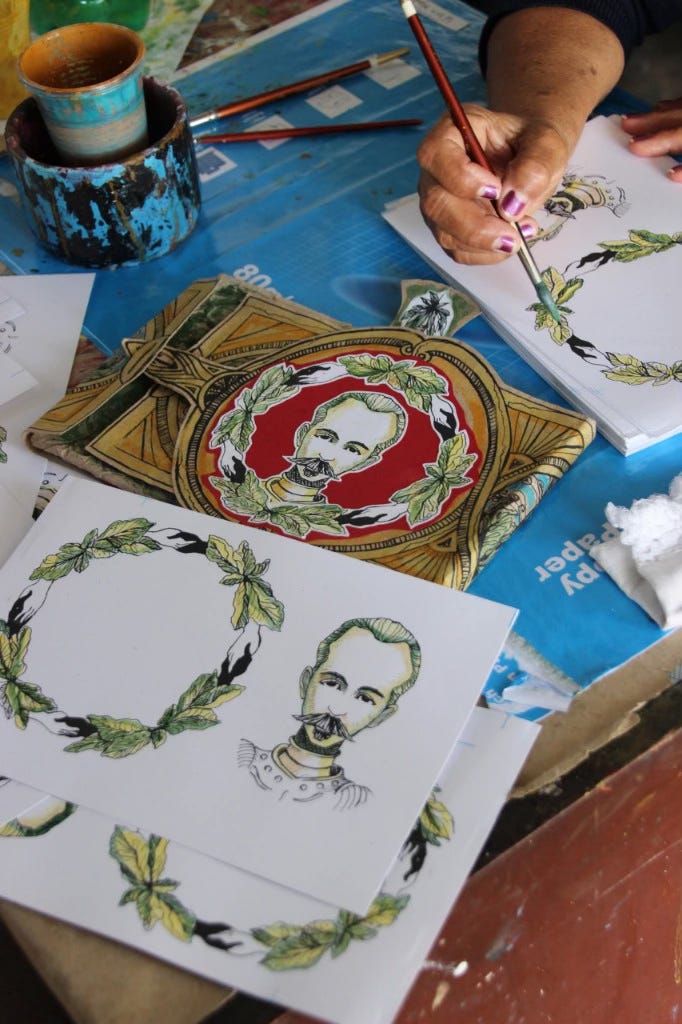
Alfredo Zaldivar, the poet, and Rolando Estevez, the artist, give birth to an exciting new idea. What if they publish their own work, and the work of other poets in the area? They don’t have a printing press, but they could borrow an old typewriter and a mimeograph machine. What if they construct the books by hand, using whatever materials they can scrounge together?
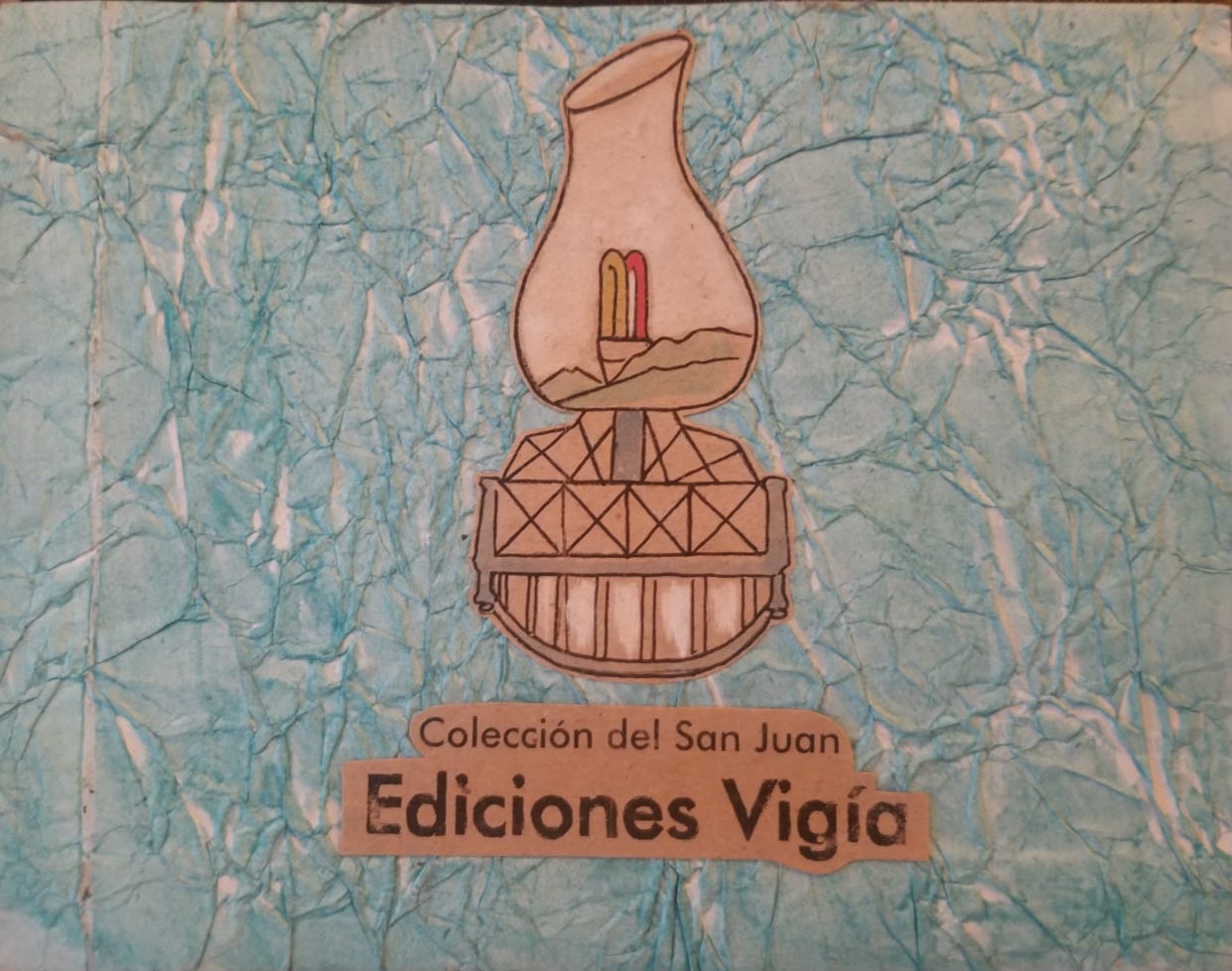
Ediciones Vigia was born.*
As a child, I was taught that Cuba was evil, because, well, the Soviet Union was evil, and Cuba was just an appendage of the USSR. In college, however, I read a different story, about a U.S.-supported dictator and idealistic Cuban revolutionaries. And my picture of the Cuban people flipped from two-dimensional demons, to heroes.
When I traveled to Cuba the first time, I encountered real people. I marveled at the creative ways they found to deal with scarcity and intermittent blackouts. Their imaginative use of limited materials inspired me.
And that’s when I first walked through the doors of La Vigia.
Matanzas is known as “the Athens of Cuba” for the city’s contributions to Cuba’s artistic and intellectual achievements.
The poets and artists and musicians of Matanzas—los/las matanceros/matanceras—are fiercely proud of their hometown. One of Cuba’s most well-known and celebrated poets, Carilda Oliver Labra, was born in Matanzas and lived there till her death in 2018 at the age of 96. Gabriela Mistral called her “la mejor sonetista de América” (the best sonneteer of the Americas), but the artists of Matanzas call her simply Carilda.
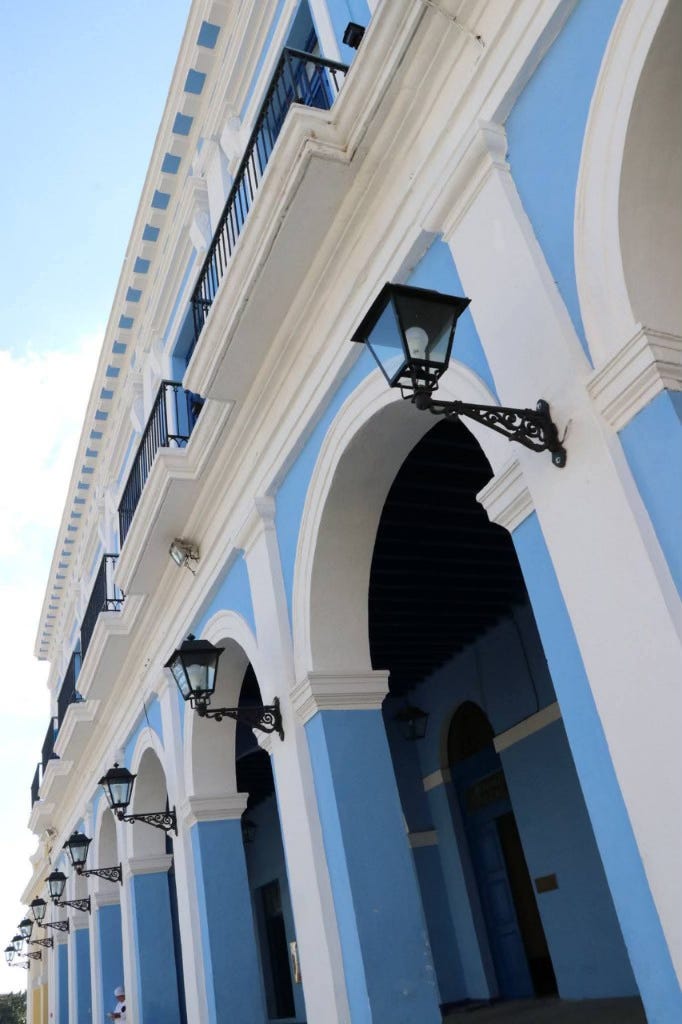
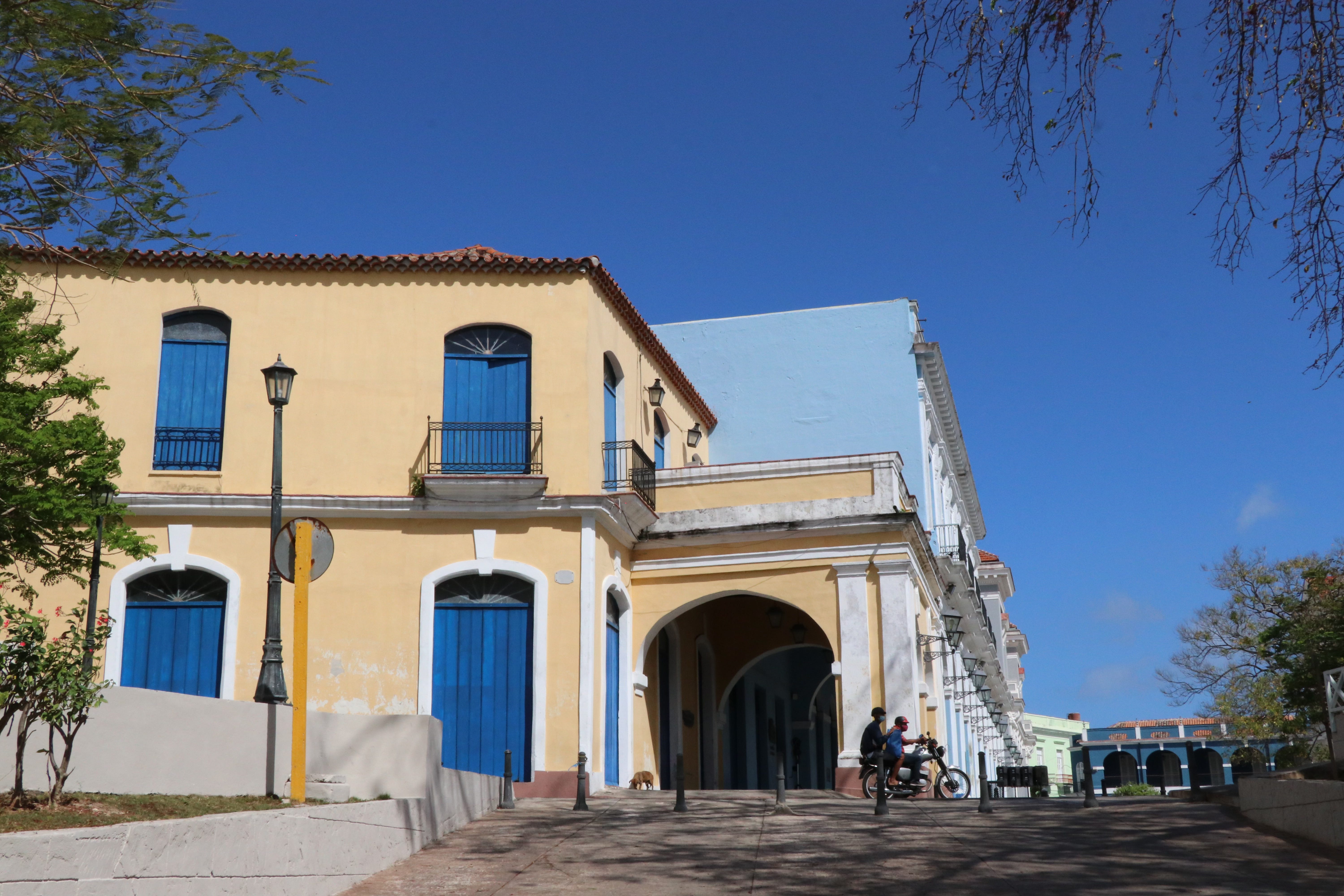
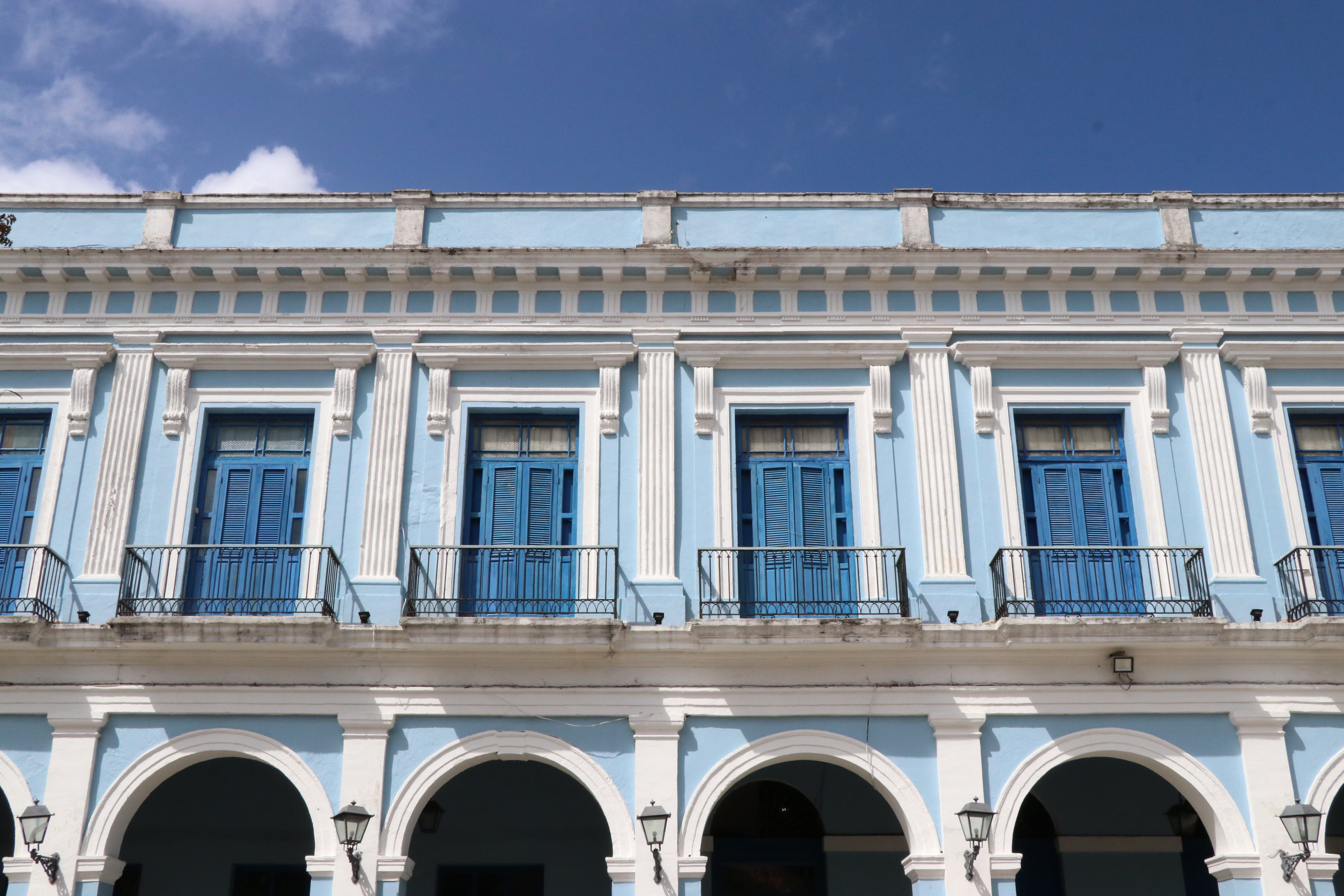
On one side of the Plaza de la Vigia, facing Matanzas Bay, is a row of buildings painted in turquoise blue and white and linked by a shared portico. On the end of that row, painted in a contrasting golden beige, is the home of Ediciones Vigia.
The first time I visited the Vigia salon was in either 2003 or 2005. I want to say it was 2003, because I remember that visit so well. It was November, and I was unprepared for that kind of heat. I soon learned that two showers a day were abolute musts for me.
The group I was with stepped out of the hot sun into the shade of the portico and from there into a cool, tiled workshop. The first floor was cluttered with ancient cash registers, tables and chairs, and construction materials, more like a warehouse than a shop.
The revelation was upstairs.
On the second floor was a large room flooded with light. The shuttered doors were thrown open, and a few fans were going at high speed. The unfiltered sun made the room about ten degrees warmer than downstairs, but still no match for the heat in the streets.
In the middle of the floor was a small square table, surrounded by women talking and laughing and wielding large pairs of scissors. Small cups of dark, sweet Cuban coffee—in 2003, cafe puro was available for a price—sat scattered on the table. In-between were sheets of paper with mimeographed images of faces and oil lamps and flowering plants.
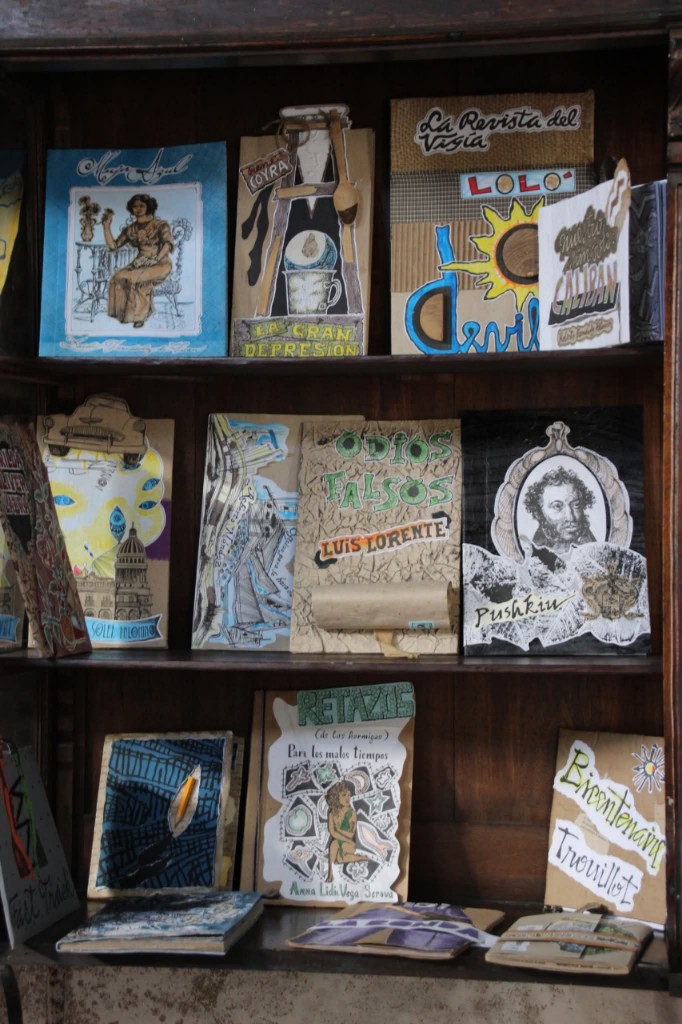
Some women were cutting out the hand-drawn figures. Others were gluing them into a book. The pages were layers of butcher block paper and newsprint, cardboard and tissue paper, a page of lace from a discarded tablecloth. The words of the poems were typed inside a hand-drawn, mimeographed border.
And the book covers! Created to reflect the themes inside, the covers were combinations of found objects and pictures cut out and colored and pasted. Sand and seashells and bits of dried seaweed, alongside a tiny suitcase constructed out of cardstock and bound together with rough brown string, adorned the cover of a book of poetry by Ruth Behar.**
The book caught my eye not only because of the cover, but because the poems were in both Spanish and English. The themes were longing and exile, love and loss. The title was Everything I Kept/Todo lo que guarde.
Later I showed the collection to my mother. She knew a thing or two about exile, about loss, about trying to keep hold of the things that were important to her. She had grown up in southeastern Virginia, a block from the Chesapeake Bay, and she loved the ocean. When our family moved to Kentucky, she took with her a jar of ocean water and another of sand. She kept them on a bookshelf in the living room.
The small suitcase on Behar’s book could be opened. The effect was magical. Inside were shells, a small tin-foil mirror, and a tiny cut-out Star of David (Behar is Jewish).
Mom turned the pages in slow silence. She said something to me—I don’t recall what. But then, the words were not the most important part. It was the sound of her voice, reverent, hushed. Like the sound of the ocean in a conch shell.
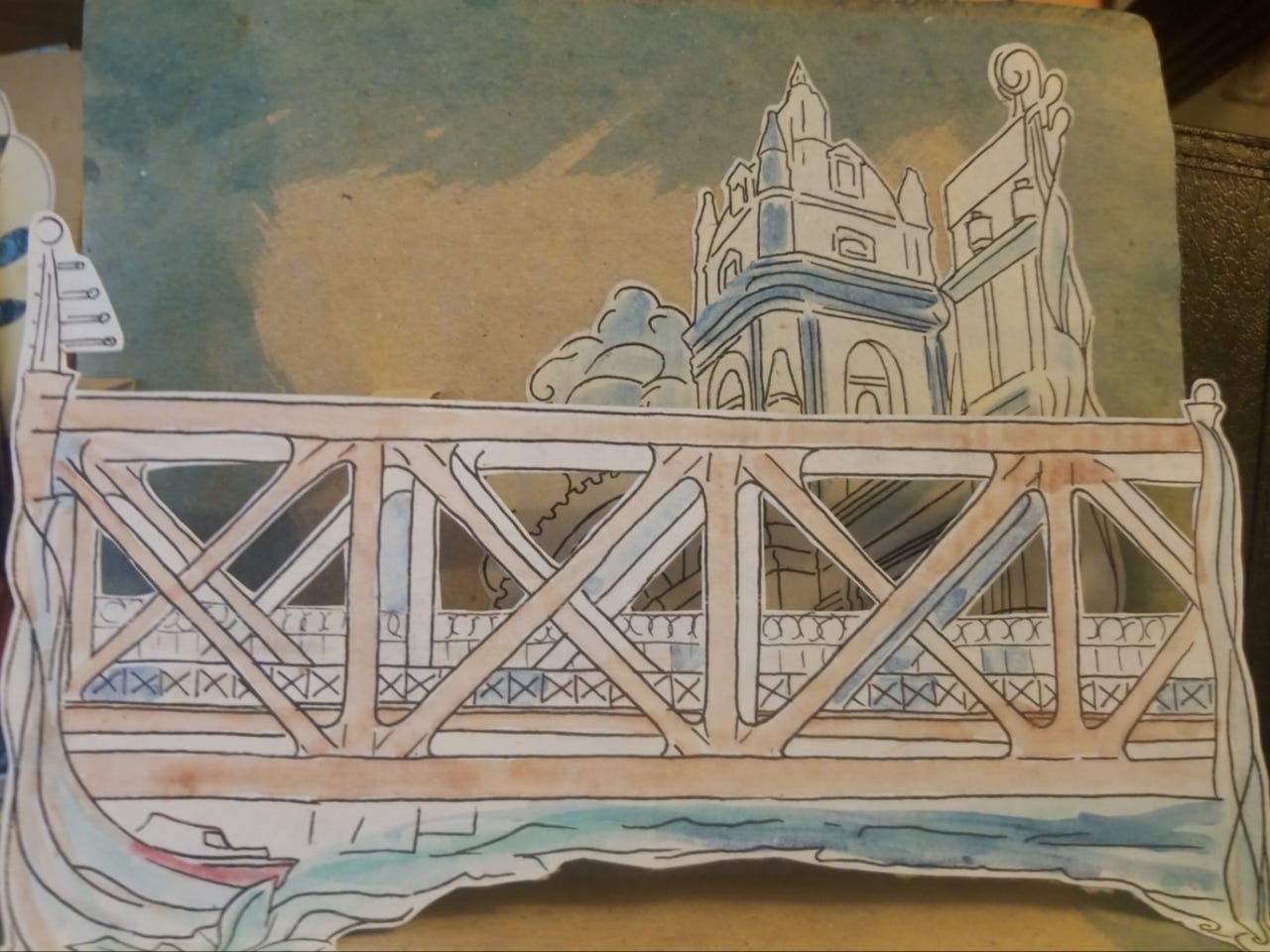
Matanzas is also known as “the City of Bridges.” I know the nickname refers to the seventeen physical bridges that connect parts of the city over three rivers. But to me the most important bridge is the one between a Jewish Cuban American poet and a woman from southeastern Virginia.
We need more bridges like that one.
I read this week that cafe mezclado is making a comeback, because cafe puro is once again in short supply. Hurricanes made stronger by climate change have damaged historic structures, and there is no money to repair them. The electrical grid for the entire island has crashed more than once in the last few months.
And why? Because the U.S.A. is blocking the oil that Cuba needs from Venezuela. The current occupant of the White House—I refuse to call him President—has declared Cuba once again a threat. To him, diplomacy is only a game of “Let’s Make a Deal.” And he gloats over the people suffering because of his policies.
“I do believe I’ll be having the honor of taking Cuba,” he says. “I think I can do anything I want with it.”
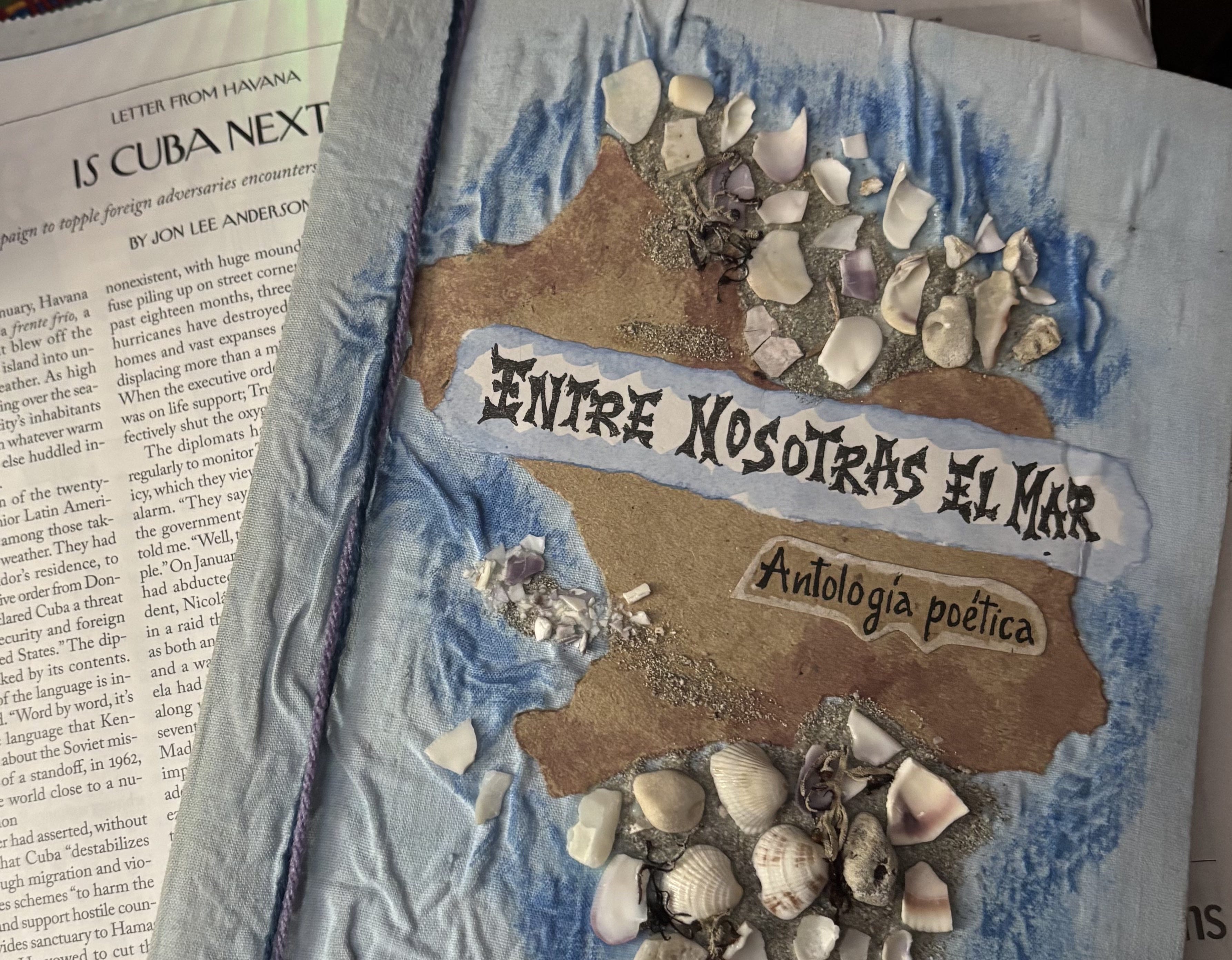
Beside me, I have an anthology of poetry, published by Ediciones Vigia, and entitled Entre Nosotras El Mar (Between Us the Sea).
I think about the narrow strip of sea that separates Key West from the beaches of Varadero in the province of Matanzas. Only ninety miles wide, those waters have claimed the lives of many who tried to cross it in rickety boats and makeshift rafts.
But the distance between Cuba and the U.S. can’t be measured in miles.
In 2005, travel to Cuba was a two-day ordeal: flying to Miami and spending the night; going to the airport early in the morning; standing in one line after another, to get this letter approved or that document stamped; passing an entire day getting to the gate, and then waiting for hours for the charter flight to board. And after all that, the flight took only 45 minutes. I remember thinking, Cuba isn’t very far away at all.
By 2020, when I went for the last time, there were direct flights that carried us from Atlanta to Havana in two hours, maybe less.
But what will happen now?
I’ll end with the words of poet Alfredo Zaldivar:
Las tormentas a veces
llegan sin annunciarse.
Las tormentas se anuncian
y quizas nunca lleguen.

Todo camino es una ingenuidad.
Todo pronostico es solo otra parabola.

Translation:
Storms sometimes
arrive unannounced.
Storms are announced
and perhaps never arrive.

Every path is naive.
Every prediction is just another parable.
________________________________________
Many thanks to Lynn Farmer, poet, photographer, friend, for the use of her photos from Matanzas, Cuba, and Ediciones Vigia. Lynn, you are one of the people who is a lamp in the darkness, una vigia de verdad.
*I am writing from memory what I was told more than twenty years ago about the founding of Ediciones Vigia. And—okay, I confess, I’m embellishing what little I know. For a more complete (and accurate!) history—accompanied by gorgeous photos of some of the over 500 books they created—visit https://vigia.missouri.edu.
**You can find out more about the poet and writer Ruth Behar at ruthbehar.com.
 holy discomfort: Love letters from a reluctant Christian