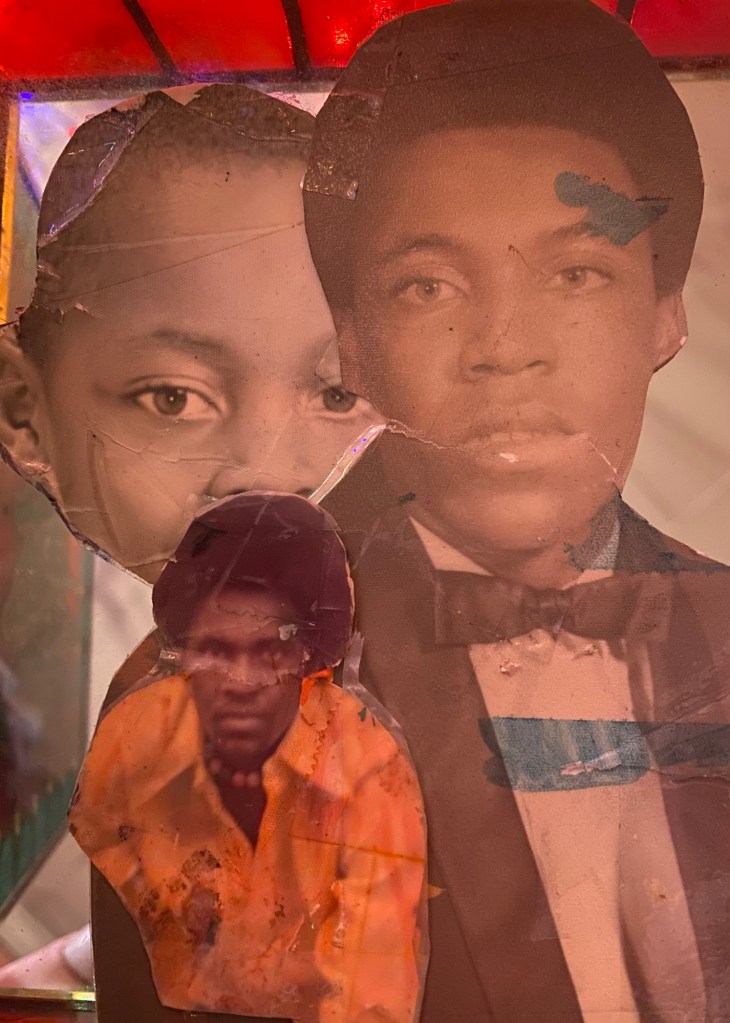
William and I are newlyweds in our early 70s.
In 1969, we were in school together for one year. It was the last year for Freedom of Choice in Wake County, North Carolina, before full desegregation. I have returned to Wake Forest to write about my family’s experience of racist violence in this place. An experience of which he was an integral part.
I ask him to share stories from his childhood.
Everybody William tells me about from his growing-up years has a nickname. Maybe two. His own nickname was Tubby. (No one knows why.) Or Linc, like the character on The Mod Squad. Or Lick, or Noon, depending on when and where you first met him. (Again, no one can tell you where the last two nicknames came from.) For no obvious reason, his brother Mike is called Perk. And his cousin was known as Sonny Boy.
“Me and my cousin Sonny Boy— His mother and my father were first cousins. Like sister and brother as children, real tight. Her name was Lucille, we called her ‘Cilbug. Her father was a Whitfield, and she married a Crump. Anyway, we called her father Whitrock.”
William’s father worked all his life for a dry cleaner.
“My dad did clothes on Wednesday, so every Thursday we’d go to visit Whitrock. And he’d be having supper. Ma Minnie—Ma Minnie was his wife—and she’d fix him a couple of eggs, over easy. Toast. Cup of coffee on a saucer, like my grandmother Mama Daisy did. You’d pour the coffee intentionally so it would run over into the saucer, and drink it that way.”
William pauses. “And he’d just tell lies.”
“What!” I say.
He laughs. “Some stories were lies, some stories were the truth. And some stories were the truth with hyperbole.
“So we’d spend every Thursday, me, Perk, and my dad, just having ourselves a good old time, laughing. He had a different story every time. And me and Perk, we’re just kids, right? And we can’t wait! ‘Hey, Dad, you ready? Let’s go.’ That was Whitrock.
“He told a true story about him and my daddy’s father. They had been drinking one night. Drinking moonshine. And they didn’t know that the moonshine had some embalming fluid. Formaldehyde shit, right?
“They used to walk the railroad tracks, inside the tracks. And that night they’re walking. They’d been drinking, right? And they were going— My grandfather’s name was Clarence, called him Monk. ‘Monk?’ ‘What, Whit?’ ‘Does it seem to you that this moonshine’s kinda different?’ ‘Yeah, but I can’t— I can’t put my finger on it, there’s something different about it, yeah.’
“So about the time they’re talking, they see the train, like, the engine, moving towards them, right. And they can’t move. They’re stuck. Not stuck in an object, they’re just stuck. Because of the amount of formaldehyde, they can’t think properly, they can’t figure out how to get out of the way. And the train’s getting closer and closer—
“And of course, that’s when hyperbole sets in: At the last minute, they both, like, dove. Dove off the track. To safety.” William shakes his head, and we laugh.
“It really happened, they did drink formaldehyde, they got stuck. But they just probably, like, walked off the track. They’re like 70 years old.” The same age we are now, I note.
His mood turns serious. “They used to say that, if they were walking downtown Wake Forest, and a White woman was coming towards them, they’d lower their heads, go over to the other side of the street. Shit like that.
“Stuff like that didn’t happen to me personally. Not until the movie theatre.”
“I never knew I was ‘Black’ until I went to the movie theater in downtown Wake Forest.”
“When did you know you were Black?” I ask William.
I am thinking about something that a new friend of mine said to me. A young woman from the U.S. who married a man born in Kenya. Her husband said to her that he never knew he was Black until he came to the United States. I had heard the same statement from a Black friend in Atlanta who was born in Nigeria.
“I never knew I was ‘Black’ until I went to the movie theater in downtown Wake Forest.”
He stops. I sit quietly and wait.
“So, living in an all-Black community, of course, of course—of course, I know I’m Black,” William begins. “I’m Black. But Blackness was, like, Pride. Self-respect. Intelligence. Basically some of the characteristics that some human beings possess, right, that are different colors from me. So, like, no big deal.
“My parents would tell me stories about how to navigate through life. Like, Mama Daisy used to work at the seminary as a cook, cooking food for White students, White professors. But then you couldn’t take any food home. You couldn’t take a plate home, right?
“Not a problem. Because, at the same time, Mama Daisy was in charge of taking out the trash, right. Like, in those little buckets? So Mama Daisy, she’d line the bottom with some foil and shit. She’d get pork chops, steaks, different cuts of meat, foil on top, another layer of foil, then fake trash on top. Go outside. After you empty the trash, go to the car, put the meat into a container, a little chest that you’ve prepared with some ice in it, to keep the meat fresh. And then bring it home. White man never knows the difference. Bring the meat home, and basically kinda smile, like, Fuck the White man.”
I shake my head. We laugh.
William continues, “So I grew up in a household that always had food, never nasty, Mom’s very organized, brilliant, my dad was a hard worker—so, like— Just like a family, right? Wasn’t like the European way of life. I didn’t know anything about how we were ‘supposed to be,’ right? Because how we were, we were a fucking family. There was no trope that we were supposed to follow. ‘Ozzie and Harriet,’ ‘The Donna Reed Show,’ all that was just entertainment.
“So, me saying I didn’t realize I was Black till I went to the movie theatre, is like, I realize that now it’s about my Blackness as it pertains to White society. The White world. And all of a sudden, I’m at the movie theater, and I notice that there are two entrances, right? One is for White people. And one isn’t. I found that odd.”
“How old were you?”
“Twelve, Thirteen? Something like that. Junior high age.”
“So 1965, ’66—”
“So it’s like, ‘Wait a minute, why can’t I go that way? Oh. Because I’m Black.’”
“Did the entrance say ‘Black,’ or —”
“No, it didn’t say anything. It’s just that, when you start to go that way, they say, ‘No, you can’t go that way—’”
“They directed you to—what? a back door? a side door?”
“No, no, you go in the front door,” he says, shaking his head. “But to the left are stairs, going up to— On a ship it’s called the crow’s nest. So, you get it? Right? Crow, Black —”
“So you had to sit up in the balcony, in the ‘crow’s nest’,” I say.
“Right. That’s when you realize that you’re ‘Black,’ meaning that, ‘Oh, so now I’m in a world of White folk who are gonna make my Blackness negative.’ My Blackness was always about Self-Respect, Pride, Intelligence. Wanting to learn, wanting to be educated.
“The White world?” He scoffs. “You don’t have respect, you’re not intelligent. You’re not even a human being. ‘You can’t sit with us.’ That kind of designation. But that’s from a White person’s mindset. That’s all. They ain’t saying shit about me, not how I see myself, right. They made me fucking angry. Because I realize, like, I’m now dealing with a race of people who are stupid. Just fucking stupid.”
Another memory comes up. His voice deepens, and his eyes grow dark. “It was actually when I was a little kid, but it left my head, right….” He speaks slowly.
“My mom was a domestic, working—her and Ella Marie, across the street—at this house, right. And there was this White girl, little girl, same age as me, right. And she came over. We’re in the yard, and we just start playing together.”
His lips press into a flat line. “Then her father pulled up in the car. I’m a young kid. And at the time, right, even though I’m a little kid—I mean, if you asked me to label it, I couldn’t—but I knew that something was wrong—”
“But I knew there was— It was something about me that caused the White man to have such a visceral reaction.”
His voice gets soft. “With him. Nothing wrong with the girl, she— The look on her face was, like….” He leaves it dangling. “And her name was Randy. And she looked at her father, right?”
William imitates her father. The words stern, clipped. “‘Randy. Let’s go. In the house. Right now.’”
Silence. He takes a deep breath.
“I told my mom, right? She didn’t say anything. So I looked at her, and she said, ‘It’s OK, baby. Don’t worry about it.’
“But I knew there was — It was something about me that caused the White man to have such a visceral reaction.”
(excerpt from my book Walking to the Edge: Break with Whiteness)
 holy discomfort: Love letters from a reluctant Christian
thank you for what you shared today—Nov 6. I am impressed with your writing and with your husband. Please sign me up for your blog. I’m not sure how to do that. Leslie shared your posting from today to the listserv. I’m reading it from my bed. Will try, tomorrow, to make myself take another step. Thank you again.
LikeLike
Thank you, Renee. Means alot to me.
LikeLike
As for signing up, go to holydiscomfort.com. There is a place for you to enter your email and click “Subscribe.” Blessings on all of us.
LikeLike