This post is the third in a series of excerpts from my memoir, From Where I Stand, a story of love across race and time.
This post follows “Choose this day….”
Mom had put a ham in the oven that morning, but forgotten to turn the oven on. When MaMaw took Bryant back to the parsonage before the business meeting, she caught the oversight. By the time we got home from church, Sunday dinner was ready.
My parents worried that, even if there were a place available to live in Wake Forest, everyone would be too afraid to rent to us. They talked about going to a hotel.
Dad suggested that Mom take my brothers and me back to Norfolk to live with Granny.
Her eyes narrowed. “And where will you be?”
“I’ll be here finishing up.”
She looked at my dad like he had lost his mind. “Oh no, I’m not going anywhere without you. If you’re staying, I’m staying.”
There was some conversation about whether to send me and my brothers to Granny’s without Mom.
My mother told me that I said, “My friends can’t leave. So, I’m not leaving.”
The phone rang, interrupting dinner. Mom answered.
“Wesley, it’s Mr. Ford. Karen’s geometry teacher.”
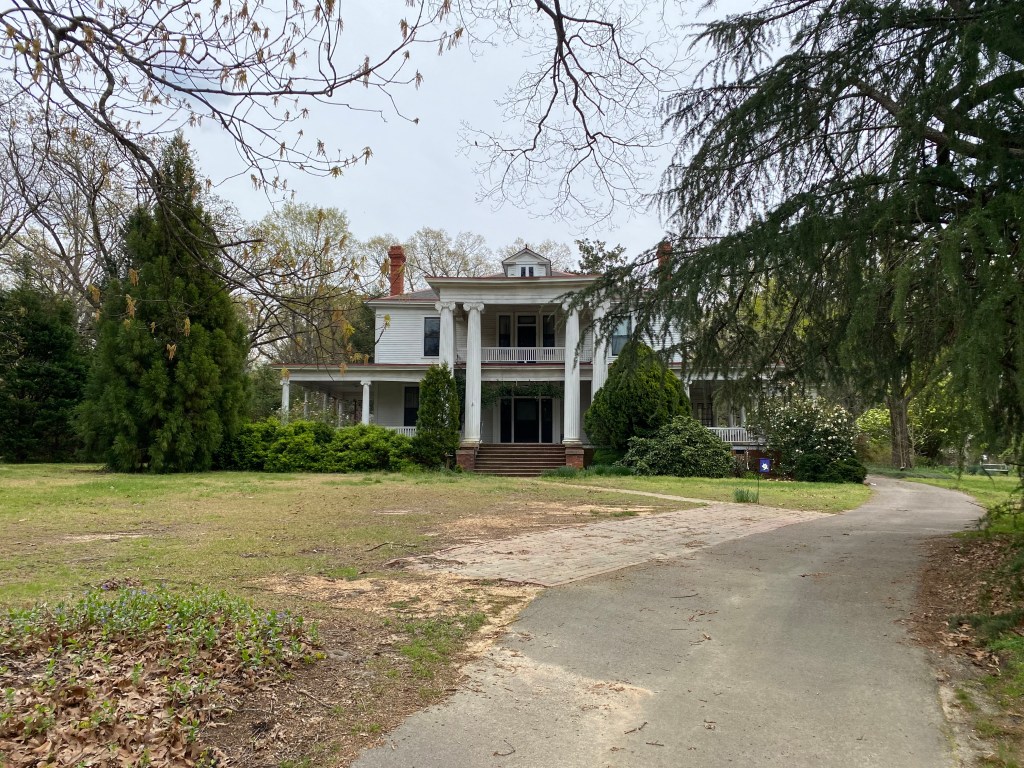
My math teacher and Drivers Ed instructor, Mr. Ford, and his wife Liz lived in the town of Wake Forest in a 20-room house built in 1912, known to everyone as the “old Powell mansion.” The house needed extensive repairs—the perfect fixer-upper project for an adventurous young couple. The Fords bought it in 1967.
As a biochemist, Liz Ford found work in the Research Triangle. Bob Ford became the math teacher for Wake Forest High School and began teaching there my freshman year.
While Dad talked with Mr. Ford, gunshots were going off all around us in the woods, both behind and in front of the parsonage. And the turkey shoot was still going on.
The Fords had found out about the shooting through Steely. As Mr. Ford drove Liz to work that morning, they had mulled it over.
“We’ve got to do something to help these people,” Liz said.
What they did was to offer us one half of the old Powell Mansion. At first, Dad believed they were offering us a place to store our furniture.
The afternoon wore on. John and I had to get going. We were supposed to sing a Christmas concert with a youth chamber choir that night.
“After the concert,” Dad said, “sit tight at the director’s house. We’ll come and pick you up once we figure out where we’re staying tonight.”
Our choir director drove us through the early dark of a late winter afternoon. We stopped at a country church, painted white. Ten old white people sat and listened, smiling as we sang Christmas carols and anthems, like “In the Bleak Midwinter.” And I sang the solo in an arrangement of an Appalachian folk carol, “I Wonder as I Wander”:
     I wonder as I wander out under the sky
     How Jesus the Savior did come for to die
     For poor o'nery sinners like you and like I.
     I wonder as I wander
     Out under the sky.
It never occurred to any of us to cancel out of the event.
Afterwards, I sat alone on the narrow porch that ran the width of our director’s house, waiting for my parents and bundled up against the cold. Polite conversation was the last thing I wanted. I needed to sit alone and still.
Everything was quiet. Shadows of bare trees against the streetlights stalked her front yard. As the headlights of occasional cars swept over the fence, I felt myself shrink back into the dark. I wanted no one to see me. There may have been Christmas lights up and down the street, but all I remember is the welcome darkness, the quiet, the cold.
After Dad picked us up, the drive to the Fords’ home was a few short blocks up North Main.
The old Powell mansion sat at some distance from the street, behind the black silhouettes of trees. A long driveway led to a two-story Southern manse, complete with sturdy white columns and a wide wrap-around porch. The driveway curved to the right and passed through an old-fashioned carriage entrance on the side. The white lights of a Christmas tree twinkled at us from a second-story porch.
We walked through the front door into a narrow foyer and almost immediately through another door with bevel-edged glass into the main hall, which was wide and welcoming. A small chandelier strung with prisms hung low in the center. To the right was the living room, with a fireplace that could have swallowed the one at the parsonage. That night there was a roaring fire, and in the corner of the room, a 9-10-foot Christmas tree, whose branches did not brush the ceiling.
Liz Ford busied herself and Bryant with decorating the tree and baking cheese straws, while my parents and Mr. Ford sat talking about the shooting, the business meeting, the dismissal. MaMaw and Granddaddy were still in Wake Forest, staying until the next day.
It soon became clear that the Fords were offering much more than storage space. They were offering us a home. For as long as we needed to stay while my dad finished seminary, they told us, we could live there rent-free.
“You know,” Dad said, “if you do this, the two of you are gonna be in danger.”
“Well, this is our fight, too,” Mr. Ford answered.
For the first few nights, my brothers and I shared the bedroom that would later be mine—my brothers’ room downstairs was still being set up.The second-floor window overlooked the front lawn. Liz had pushed together a double bed and a couple of twin beds for us.
Both exhausted and keyed up, John and I talked some until our eyes got heavy. As we drifted off to sleep, we heard singing below the front window, a group of Christmas carolers. My brothers and I lay in bed, lulled by the sounds of familiar carols: “It came upon the midnight clear….” “Silent night, holy night….”
We shall overcome, we shall overcome…
We bolted upright, wide awake. Tumbling out of bed, we charged down the stairs into the front hall and out onto the porch.
My father could never tell the story without choking up. “And, would you believe, it was snowing,” he said. “The snow was coming down—” My mother illustrated his words, fluttering her fingers as her hands descended slowly through the air.
I remember the snow, but I thought I had imagined it.
A group of 15-20 white seminary students and professors stood below us on the lawn, their arms crossed in front of them, hand in hand, swaying from side to side like civil rights marchers. The snow fell, silent and steady, sticking to the concrete steps and accumulating on the grass and bushes. We joined hands and began to sing with them.
Oh, deep in my heart, I do believe…
They continued to sing as they dropped their hands and moved off across the lawn.
…that we shall overcome some day….
We heard their voices all the way to North Main Street, trailing off as they turned and walked out of sight.

