This is the fifth in a series of excerpts from my memoir, The Edge of All the Light You Have (formerly, From Where I Stand).
In the cartoon, a portly man, in clothes several sizes too small for him, stands in front of a church, a double-barrel shotgun stuffed under one arm. Above him is a waning crescent moon, and beside him is the Ridgecrest Baptist Church sign, which reads THOU SHALT LOVE THY NEIGHBOR AS THYSELF, UNLESS HE’S BLACK. The man folds his stubby fingers in prayer and says, “Amen.”
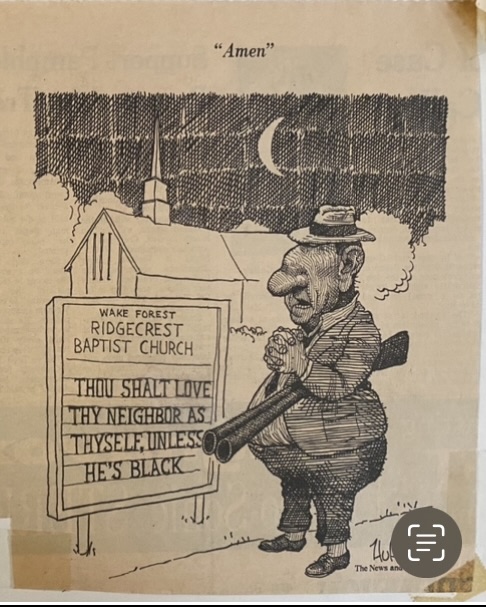
On Tuesday morning, December 16, 1969, this cartoon commanded the top of the editorial page in The News & Observer. The man bore a striking resemblance to Ruben Bailey, owner and operator of Bailey’s Grocery, almost next door to Ridgecrest. Mr. Bailey’s wife was a member of Ridgecrest. And Mr. Bailey had said to anyone who would listen that, if his daughter were to date a “n****r,” he would “shoot them both down in the road like dogs.”
The first articles about the shooting appeared that same day in The News & Observer in the morning and The Raleigh Times in the afternoon. The front page headlines read “‘Harricane’ Eyes Violence,” “Clues Sought In Shooting Into Home,” and “Minister’s Home Blasted.” Photos of my father, our family, and me were in both editions—including the photo my mother hated.
The reporter recorded snatches of conversation overheard in Bailey’s Grocery:
          …a hunter…said banteringly to a small group
     of men in the place, “What you all trying to do,
     run all the preachers out of here?”
          A small wiry man with skin tight over
     prominent cheekbones replied in a measured
     voice: “They ought to be run out —kill ‘em all
     if they take n****rs in the house.”…
          “Well, he was warned,” said a farmer. "He
     knew people around here don’t go for that.”…
          “It’s the newspapers that keep stirring it up,”
     said another storekeeper.
          A man leaning against a counter said: “Yeah….
     Did you see that cartoon?”
On the one-week anniversary of the shooting, the sound of gunshots peppered the air outside the Fords’ house. Their dogs began to bark and pace the front hallway.
The Fords had two large Chesapeake Bay retrievers, the sweetest, most mild-mannered dogs imaginable, with chocolate-brown hair in tight curls and droopy sympathetic eyes. They slept upstairs in the bedroom behind mine. Last thing before I went to sleep, I would hear them galloping up the stairs when they were brought in for the night.
Now, the dogs were going crazy, running back and forth in a frenzy.
Mom recalled having seen a car cruise up and down North Main Street earlier in the week. It slowed down in front of the Fords’ house before speeding off. Then, it circled back around, slowing down and speeding off again.
The Wake Weekly had wasted no time in publishing where we were living after moving from the parsonage.
“Why don’t they tell people which side of the house we’re living in?” Mom said, a bitter edge to her voice. “That way, they’ll know where to shoot.”
Dad’s concern was that someone might try to sneak up on the house from behind. The woods on the back of the Fords’ property stretched all the way to the railroad tracks. So, Mr. Ford grabbed his rifle, and Dad, his shotgun. They spent much of the night in the dark out in a little camper parked beside the house, waiting and watching.
My parents knew that the State Bureau of Investigation (SBI) was keeping an eye on the house. Mom and Dad had seen officers stop a car on North Main and search the trunk. And the SBI kept in regular contact with my dad.
We did not know it at the time, but were told later, that people living in the Black community on the other side of the tracks were watching both the railroad tracks and the back of the Fords’ house. They literally had our backs.
One night a white man came to the door. He introduced himself as an agent with the Federal Bureau of Investigation (FBI), working undercover inside the Ku Klux Klan.
“You need to be careful,” he said to my father. “Because your family picture is on the bulletin board of every Klan headquarters. And they would love to catch you and kill you outside of Wake County, so that it would look like it doesn’t have anything to do with this shooting.”
He and Dad talked for a while, under Mr. Ford’s watchful eye, before the man left.
As Dad shut the door, he said, “Was that a warning? Or a threat?”
My father later told me that the man turned out to be who he said he was. I don’t know how he found out. We never saw the man again.
The newspapers, meanwhile, reported that the FBI had decided not to take up the case.
Before the shooting, the threat of terror had no part in my life. Now, there were new rules, new behavior:
Never walk home alone, from school or anywhere else.
Never go anywhere alone.
Don’t leave the window curtains or blinds open at night.
Don’t walk between a light and a window, because your shadow will be cast on the curtain.
Don’t turn the lights on every time you enter a room. And don’t turn the lights off every time you leave a room. (“Anyone watching the house can trace your movements,” Dad said.)
I turned the last one into a game, flipping the lights on as I left the room and turning them off as I entered. Thumbing my nose at anyone who might be lurking outside. Maybe I imagined the stratagem gave me some measure of control over the situation.
The threat of violence hung over the lives of people in the Harricans, too. In one of the early editorials, someone identified as a “member of the board of deacons” at Ridgecrest was quoted as saying that he was “real sorry” about the shooting. Then he pleaded with the reporter not to use his name.
“It could be my house tonight if someone heard me say that.”
 holy discomfort: Love letters from a reluctant Christian