The intersections of infamy in our Southern history astound me.
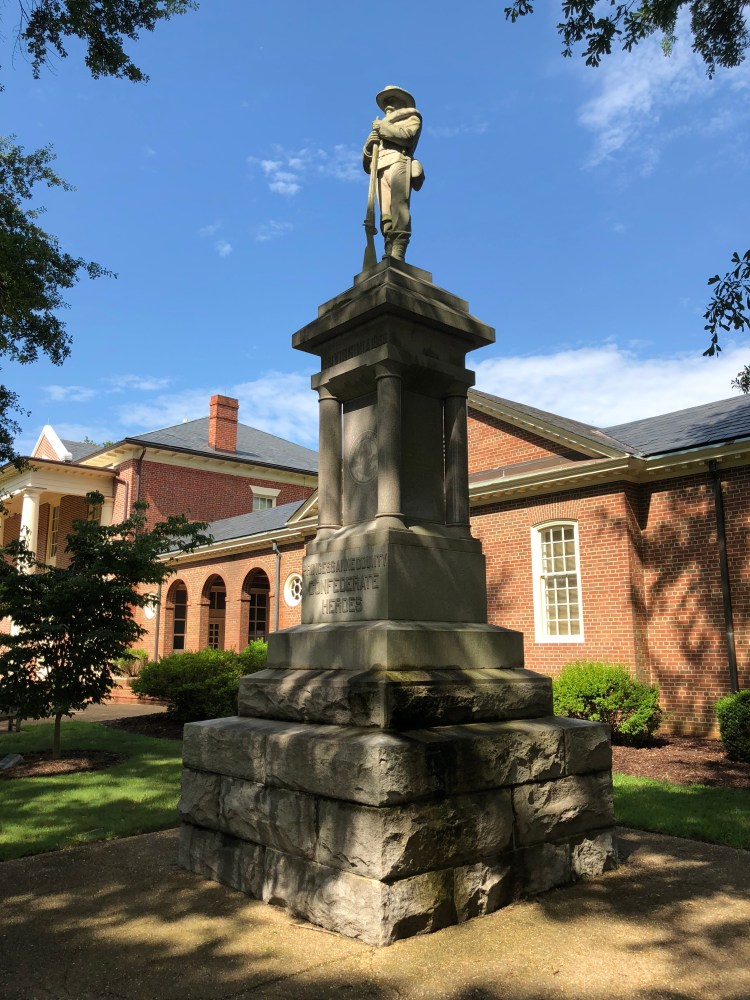
(Photo taken in 2018 by K Bryant Lucas)
When I was growing up, no one ever mentioned that there had been a lynching in Princess Anne County, right around the corner from my grandparents’ farm.
The first time I learned about Noah Cherry was in 2019, at the Legacy Museum of the Equal Justice Initiative (EJI) in Montgomery, Alabama. I was visiting with a church group. We stepped inside the dark cool entrance of what looked like a small building tucked between two others. But, once inside, I saw that the narrow lobby opened into a space that was deep and wide.
The first exhibit we passed was a row of prison cells, replicas of the ones that held Black Africans on their way to the slave market. In each cell was a holographic image representing an enslaved person. The ghostly figures moved as they spoke in the words of old slave narratives, their voices overlapping in the darkness.
On the end of the row was the ghost of a woman about my height, dressed as a house servant. She looked me in the eye as she talked. At the same time, she seemed to be looking at something beyond me. I felt like an interloper, an eavesdropper—an outsider unable to enter the space she was describing. As if I were the ghost. And then—God help me—she began to sing: Hold on just a little bit longer…. I know justice is coming soon. There was no holding back the tears—and this was only the beginning of the tour.
Large photos and exhibits throughout the museum told stories of mass incarceration, unjust executions, and the current practice of hiring out prison inmates as farm laborers, replicating in the 21st Century the practice of chattel slavery. To one side, gigantic jars filled with soil sat on shelves lining the wall. Some of the soil was loose and black or brown, some was in chunks of red clay. The soil samples came from lynching sites across the United States, and each jar bore a name and the date the person was lynched.
I thought, Were there any lynchings in Princess Anne County? A student intern, an enthusiastic young Black man majoring in history at the University of Alabama, pointed me to a virtual map. All known lynchings, he told me, were noted there with small red dots.
I bent over the map. In what used to be Princess Anne County, now Virginia Beach, Virginia, was a single dot, and, beside it, the name, Noah Cherry. I read it out loud. It was the first time I’d ever heard his name.
The young man told me that organizations could claim a marker from EJI for someone who was lynched in their area. The process to qualify to receive a marker, he said, was complex and lengthy, and it included the ceremonial digging up of the soil that I saw in those large jars.
“No one has claimed Noah Cherry’s marker,” he told me.
From the museum, my group drove over to the National Memorial of Peace and Justice—what many people called the lynching memorial. We piled out of our van and made our way to a low pavilion, open on all sides, on top of a hill in front of us. When we entered the pavilion, we began to split up, moving at different speeds.
The walkway led us through a cluster of rectangular slabs, rust-red and brown, hanging from the ceiling. Each one carried the name of a person who was lynched, along with the county and state where it happened. I paused and read each one—I wanted to take it all in. At first, all the slabs were eye-level, but, as the walkway gently descended, they rose higher and higher above our heads, forcing us to look up. Everyone around me, Black and white, got real quiet.
They dangled above my head, those memorials, and from below I could see that they multiplied, spreading into rows of dozens, hundreds of others. I lost all sense of individual markers and was swept into the hugeness of what I was seeing.
I could no longer easily read the names. I am standing below them, I shuddered. I am standing below them like the whites who lynched them.
At the bottom of the walkway and around a corner was a long black wall. Water was flowing over it, and words from the Bible surfaced in my mind, words I’d heard my father preach on, “…let justice roll down like water, and righteousness like an ever-flowing stream.” I can’t remember, but I think maybe the Bible verse itself was engraved into the wall.
Then, without warning, there it was, suspended above my head— “Noah Cherry 11.15.1885.” On the marker, Virginia Beach was named as the location instead of Princess Anne County. But in that instant, everything I was observing from a slight distance became shockingly personal. I swore right then and there—swore to God—that I would not forget Noah Cherry.
On the ride home, I planted myself in a back corner of the van, away from the others. I didn’t feel much like talking.
The windows were a moving picture of cars and trucks rushing this way and that on the interstate. From my seat in the back, I watched the sky flame up into orange and red in the light of the setting sun and then go dark.
On Sunday night, November 15, 1885, Noah Cherry was lynched across the road from the Princess Anne County Courthouse—the same courthouse where Granddaddy refused to give a poll test to Black people who came to register to vote. The site of the lynching was within shouting distance of Courthouse Elementary School, my 6th grade school, and less than a mile from MaMaw and Granddaddy’s farm.
According to the newspapers, Alice, the youngest child of a local farmer, Charles D. Powell, was murdered on November 13, 1885—Friday the 13th—on her way to school. Her body was found on Holland Swamp Road. The murder was gruesome, reported in salacious detail. The newspapers said that she was attacked with an axe, her head almost completely severed from her body, dragged into a thicket, and her underclothes torn when her murderer “attempted an outrage” which “did not succeed.” The lunch that she took with her to school lay scattered and partly eaten—by the murderer, the reporter speculated. Her schoolbooks were missing.
Two men were brought in and questioned. Then someone remembered that young Noah Cherry was a farm laborer who worked for Alice’s father. They had heard that, the day before her murder, Noah had been fired after an argument with Mr. Powell’s son.
Once a Black boy was suspected, the wheels of injustice shifted into overdrive. On Saturday Noah was arrested and jailed. Evidence, either discovered or planted, sealed the public’s conviction of his guilt before he went to trial. One of Alice’s books was said to have been recovered from the side of the road between the site of the murder and Noah’s house. A contradictory account reported that all her books were found hidden behind a pine tree, wrapped in “the boy’s clothing.” There were “blood spots on the clothing and books,” spots construed to confirm Noah’s guilt. (“Blood spots” —the description struck me as odd, since Alice had been found in a pool of blood, almost completely decapitated.) And, for some unfathomable reason, Noah allegedly wrote his name above Alice’s in the front of her reading book, along with a cryptic message: “Noah Chry—Books. Pleas don’t.”
On Sunday night, November 15, about 11:00 pm, a mob of 150-200 people, all but two of them reportedly masked, stormed the jail in the Princess Anne Courthouse. They overpowered the jailer, although it was unclear how much he resisted them. One account said that he convinced the mob to allow him to go and calm his wife, who suffered from a nervous disposition. He didn’t have to go far, they lived in the same building as the jail. He refused to give the mob his keys, but having no keys posed no problem for them. They used the crowbars and sledgehammers they had brought with them to break into Noah’s cell and dragged him, half-dressed, outside.
Noah tried to escape. They shot him in the arm. A noose was placed around his neck. He was advised to pray. The paper reported that, on his knees, he confessed to the crime. Then he was pulled straight up from the ground by the noose and hung on the limb of a pine tree that stood across the road from the Courthouse.
Noah didn’t die quickly. The mob used him for target practice. One account said that Noah was shot 16 times; another, that his body was riddled with 100 bullets.
He hung on a branch that stretched out over the road, readily visible to passers-by. Children must have walked past and under his lifeless body on Monday morning on their way to school. When he was cut down on Monday afternoon, a hasty inquest was performed. The coroner reported that Noah “came to his death by being hung by the neck and several gun or pistol shot wounds to the body.” No one was accused—the coroner’s report read that the deed was done “by person or persons to the Jury unknown.” His body was buried without ceremony in the jail yard. And pieces of the clothesline used to hang him were given out as souvenirs.
Other details about Noah’s life were—as Granddaddy might have said—few and far-between. Virginia papers reported that he lived with his grandmother on Holland Swamp Road. She was arrested and taken in for questioning, but there was no follow-up, and I could find nothing else about her. One or two of the articles referred to a Noah Cherry in North Carolina, who may or may not have been young Noah’s father or grandfather. In 1878, the older Noah Cherry had been found guilty by an all-white jury of the murder of a white woman and her husband near Goldsboro. Evidence was circumstantial and contradictory, based on the testimony of a questionable eye-witness, and the older Cherry protested his innocence to the end. The jury found him guilty after deliberating for a few hours, and he was hung a week later. Young Noah would have been about 8 years old.
The younger Noah’s jailer was named Robert Murden. My MaMaw Shipp was a Murden before she was married. Searching through my genealogy, I have found a few Robert Murdens who are the correct age to be candidates. But even if none of them turn out to have been the jailer, I know in my bones that my ancestors, both Shipps and Murdens, were part of that mob. The thought makes me ill.
And who knows? The tree could be standing there still.
What I know too is that, even now, white society looks at young Black boys and girls and judges them as adults. And I know that the lurid details of attempted rape played right into the hands of a favorite racist trope. For hundreds of years now, racists have depicted Black men as the sexual predators of white women—even though it was the white enslavers who preyed on the Black women they enslaved.
Twenty years after Noah’s lynching, a Confederate statue was erected beside the old courthouse. Over 700 monuments to “the Lost Cause”—the myth that the Confederate cause was noble and had nothing at all to do with safe-guarding the practice of chattel slavery— were erected all over the South in the early 1900s by the United Daughters of the Confederacy (UDC). These monuments were most often placed at the entrances to courthouses, where folks went to seek justice or to register to vote. For Black people, they served as warnings, concrete reminders that they lived in a Jim Crow society where they were not likely to receive justice.
In the same year that the Confederate statue was erected in Princess Anne (1905), Thomas Dixon Jr. published The Clansman, the book on which the film The Birth of a Nation (1915) was based. I was amazed to discover that Dixon graduated from Wake Forest College—the same campus that later became the seminary my dad attended—two years before Noah was lynched.
The intersections of infamy in our Southern history astound me.
The last time I visited Princess Anne, in 2018, MaMaw and Granddaddy’s house was gone, replaced by a shiny new high school big enough to hold a small town. The bungalow where my mom and dad lived when they first got married was still there, but it had been added onto and covered with red brick. West Neck Road and Sandbridge Road had both already been widened, and gentrified neighborhoods—the kind with only one way in and out—were springing up all over what used to be open fields.
The old courthouse looked much as it did when I was growing up, but the people in charge of restoring historic buildings were talking about returning it to its original 1822 appearance. The elementary school had been turned into an office building, but appeared to be vacant, unused, like it might not be long for this world.
At the time, the Confederate statue on the courthouse grounds was still standing. But it was removed in the summer of 2020, after Black Lives Matter protests spurred by the murder of George Floyd by police officers in Minneapolis.
The world moves on.
I can’t stop thinking about the promise I made not to forget Noah Cherry.
Noah’s grave is somewhere on the grounds of the old Princess Anne County Courthouse on North Landing Road. It has never been found. With all the new construction in the area, I’m afraid it never will be.
And as of this writing, the EJI memorial for Noah Cherry remains in Montgomery, Alabama, unclaimed.
_________________________________________________
New information about the county records of Alice Powell’s death raises questions about the story the newspapers reported. When exactly did she die? And what were the circumstances around her death? Paul Bibeau reports his findings.
That Noah Cherry was lynched, however, is not in question.

