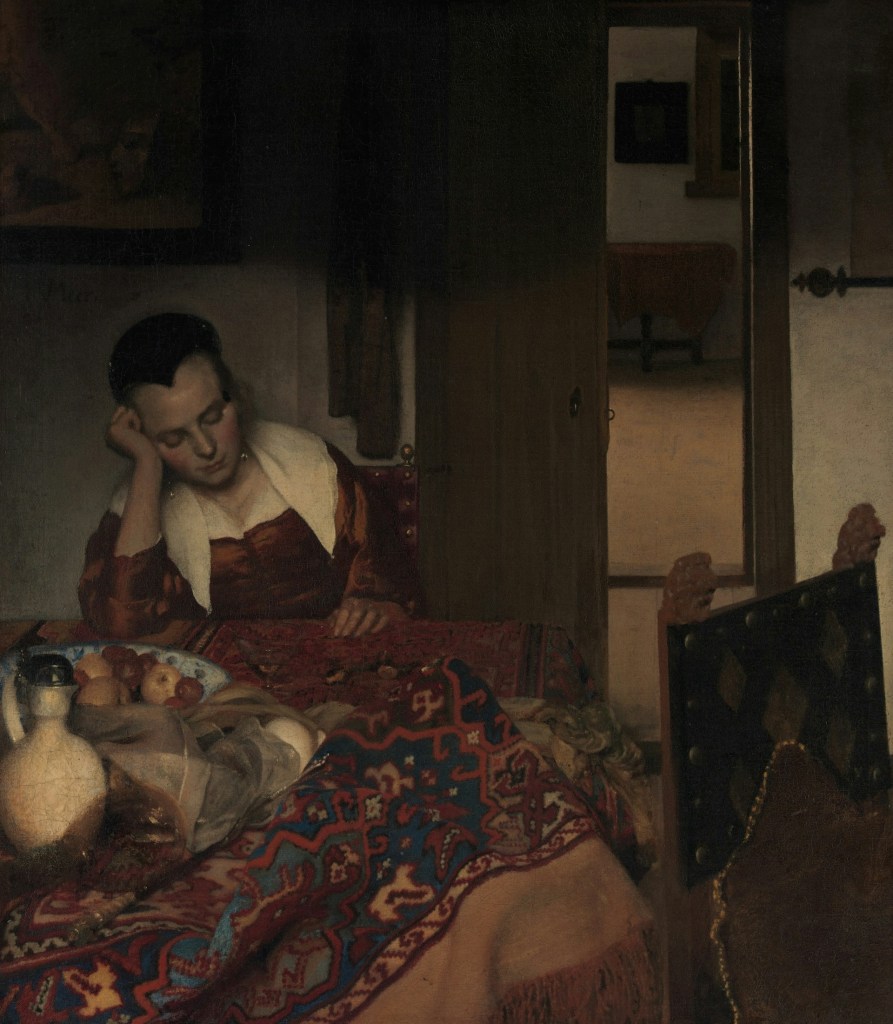
When I was a graduate student, I had a poster of Johannes Vermeer’s “A Woman Asleep” taped to the outside of the closet door in graduate student housing where I lived with my first husband. I loved the quiet emptiness of the picture, her fingers curled and resting on the table, her head leaning into her other hand. And the colors — rich burgundys and browns, golds and reds — in the foregrounded carpet, which created a gentle barrier protecting her private reverie.
I didn’t see the wine glass in front of her. (I can barely see it now.) I didn’t ask who the woman was, or how Vermeer painted it, or what layers lay underneath. It made me feel a certain way, and that’s all I cared about.
You know, to be honest, a bit more curiosity would have been helpful in my life. My then-husband was a man from the other side of the world, whose layers I did not explore ahead of time. Three years after we said I do, I lay my head down on the long, dark table in a judge’s chambers and sobbed when His Honor scolded us for trying to file for divorce without hiring a lawyer.
But I was writing about Vermeer —
“What keeps us stuck in front of Vermeer paintings for so long,” Susan Tellman writes, “is as much about what is withheld as it is about what is shown. Vermeer doesn’t tell us what to think or even really what was going on — again and again he arranges things so you cannot know.” (“Vermeer’s Vanishing Act,” The New York Review of Books, November 5, 2026).
Now I know that there was once a man in the background of that painting, just outside the door; also, a dog. Vermeer chose to paint over both of them, leaving the woman to nap in peace.
Across the face of an issue of The New Yorker a few years ago, I scrawled in thick black marker, “KEEP!!!!”
I don’t know where the magazine ended up. But with only the barest of cues — artist/painter, born South Africa, white — I was able to find the essay I wanted online. About the artist Peter Sacks.
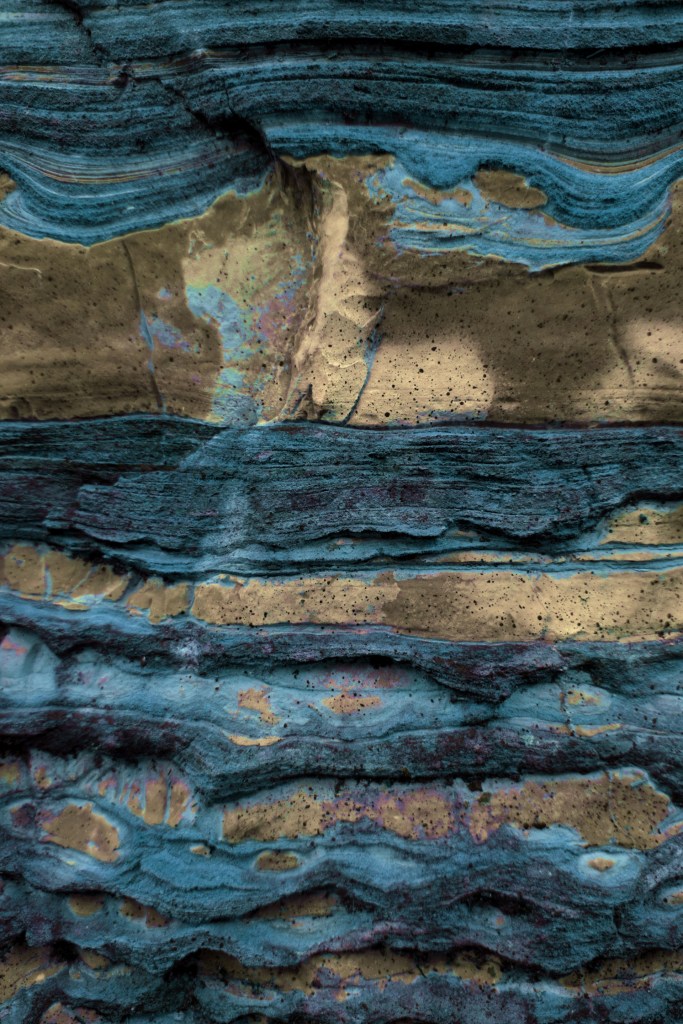
Joshua Rothman writes, “[Sacks] pointed to a raised square area. ‘This is an older painting that’s been buried,’ he said. He indicated an intricately patterned confluence of fabrics: ‘This has been burned.’ He ran his fingers along undulating waves of type. ‘I think of these as works of uncovering,’ he said. ‘I’m trying to do justice to my feeling of what the mind is like — it’s sedimentary.’” (“What Lies Beneath,” The New Yorker, March 18, 2019.)
All of a sudden, a memory pops up: Mrs. Holmgren, my English teacher in 7th grade. She expressed concern to my mother that I never erased mistakes: “She rips up the paper and starts all over again.” My mother took Mrs. H’s comment seriously enough that she shared it with 12-year-old me.
But I had my reasons: I did not like the unsightly smudge the pencil eraser left on the page.
I came by my perfectionism honestly. My brothers and I were assigned house-cleaning duties every weekend. We alternated between (a) cleaning the two half-baths in my grandmother’s house plus vacuuming, and (b) cleaning the one full bath plus dusting. Or perhaps the two small bathrooms were coupled with dusting, and the large bathroom with vacuuming? I’m not sure.
Our mother inspected our work when we were through. If she found one smudge on the bathroom mirror, we had to clean the entire bathroom again. Because, you see, that one smudge called the whole job into question.
In all fairness, Mom was going through difficult changes at the time: living with her mother, with whom she’d never been close; grieving the recent death of her much-loved father; raising three children in her mother’s house, while her husband lived 100 miles away, working in a fury to finish his Bachelor’s degree in his early thirties.
Talk about layers….
But I was writing about Sacks —
During his interview with Rothman, Sacks “took a notebook down from a high shelf…. ‘This is from the nineties,’ he said…. ‘Crossed-out writings…quotations from a Greek poem…notes on Vermeer.’”
“…notes on Vermeer”?!
What a curious intersection to stumble across now — unnoticed before.
And speaking of intersections — which way do I turn?
Age 73, and I am learning, just now, how not to tear up the smudged page, or trash the imperfectly written essay — or throw away the flawed life.
Life as palimpsest. What I choose to hide or reveal. How what is hidden lives and moves within what is revealed — and the other way around. Layers of sediment that give shape to my life, my writing.
Sacks again: “What’s visible is always in tension with what is being obscured, what is underneath.”
I, who have a tendency to say too much, to overexplain — like what I just did there, you see?! — I am thrilled by what Vermeer and Sacks do not tell me. What they leave to me to puzzle out. Or where they leave me, in the space of unknowing.
Now! how my love of Van Gogh — extravagant and wild — fits in here, I have no clue.
Perhaps more will be revealed.

