This post is an excerpt from my memoir From Where I Stand, a story of love across time and race. The place is Wake Forest, North Carolina, a small town of about 4,000 people. The time is 1967-1968, about three years before the total desegregation of Wake County schools.
Beginning in the late 1950s, my father followed closely the preaching of Rev. Dr. Martin Luther King Jr. I witnessed my father grappling with the racism of the Jim Crow South he had grown up in. And both my parents were teaching me and my two younger brothers that all people are God’s children, which makes all of us siblings.
But at age 14, I was busy studying how to be “a good girl,” how to people-please and fit in, how to get along and belong. How could I foresee that the gospel of love that our parents were teaching us would end by making us the target of hatred and violence?
In the fall of 1967, I entered Wake Forest High School as a freshman. So did Evonne Peppers.
Evonne was one of four Black girls from W.E.B. DuBois High School who elected under Freedom of Choice to attend Wake Forest High in 1967.
Freedom of Choice: the name itself was a cross between false advertising and stalling tactics. The policy appeared to comply with the Supreme Court ruling in 1954, Brown v Board of Education, that “separate, but equal” was unconstitutional. Parents were free, at least theoretically, to choose the school their children would attend, regardless of race or color. But Black parents who chose to send their children to predominantly white schools were harassed and threatened. In the late 1960s, the Ku Klux Klan, then at the peak of its membership in North Carolina, targeted anyone who tried to step over the color line.
In 1967, a Black man, whose children attended a predominantly white elementary school near Wake Forest, came home one night to find a cross burning in his yard. The next day he discovered that the well that his family depended on for drinking water had been contaminated with kerosene. The Raleigh paper, The News & Observer, kept the story alive, but county officials sat on their hands. By the time they got around to investigating, it was too late to prove that a crime had been committed.
In the town of Wake Forest, Evonne, Jeanette Massenburg, a junior, and Rhonda Hood and Theresa Watkins, both seniors, were the first students to cross the tracks and desegregate Wake Forest High.
At age 14, blinkered by whiteness, I had no idea what Evonne and the other girls were going through. I did not recognize what was happening in the hallways of my own school.
Not until I talked to Evonne in the spring of 2022.
Every morning, Evonne told me, her mother stopped her as she was walking out the door. “Evonne, please don’t go. I don’t know what’s going to happen to you.” Begging her. “Please. Don’t go. I don’t know what’s going to happen.”
What happened was that, in the same hallways where I walked freely, the four girls were spit on, called names, blocked from getting to their classes. And since they were in different grades, each of them was basically alone.
As the only Black student in her math class, Evonne was assigned a seat in the front row. The white students sat several rows behind her, calling her n****r and throwing spitballs at the back of her head.
When she complained, the white teacher—the mother of a girl I knew from church—did nothing to discipline the white students. Instead, she told Evonne, “You just have to do your best to ignore it.”
“How was I supposed to learn anything,” Evonne said to me, “with spitballs being thrown at the back of my neck?”
Not every class was as inhospitable as her math class. In some classes, she said, “The white students seemed to want to welcome me. Those periods were a safe haven in the day.” The teachers in those classes were themselves welcoming, and there is no doubt that they modeled for the students how they should behave. But once Evonne left those classes, the harassment began again.
Suddenly and unexpectedly, she said, “You were one of the students that were very welcoming to us. You and Marjie Boal always had a kind word and a smile. You’ll never know how much that meant to me.”
My face flushed and went warm. I was embarrassed. I don’t remember going out of my way to be friendly. I am happy that she felt welcomed by us. But how sad it is, I thought, that simple kindness and courtesy should be such a big deal.
Evonne and I were friendly inside school walls, but outside of school we never hung out together. Social venues on the white side of the tracks were segregated, I’m sure—in practice, if not by law. All the classmates I saw outside of school, at church or anywhere else, were white.
“It was one of the loneliest times of my life,” Evonne said. In the end, the experience at Wake Forest High proved to be too lonely, too isolating. She missed the warm encouragement of teachers at DuBois, Black teachers who genuinely wanted her to succeed. Their attitudes stood in sharp contrast with the lack of support, or at best uneven support, coming from white teachers at Wake Forest High. And her mother’s intense anxiety increased and pulled at her every morning she walked out the door.
After six months, Evonne returned to DuBois.

At the same time that Evonne was struggling, I had a sturdy circle of friends. Between church and school and community events, my social life was full and busy. For the first time since my dad had become a preacher, I fit in. I belonged.
I joined the Youth Choir at Wake Forest Baptist Church. We rehearsed every Sunday afternoon for the Sunday night service. Each week, ladies of the church fixed dinner for us, giving us a chance to mix and mingle during the hour between rehearsal and service.
In 9th grade, I was allowed to begin dating. We went to school dances and parties, church-sponsored hayrides, movies. None of us were old enough to drive, so our parents picked us up and dropped us off.
My girlfriends and I had pajama parties. We stayed up as late as possible, listened to music, talked about the boys we had crushes on, consulted the Ouija Board. We told what we thought of as “off-color” jokes. I didn’t understand most of them, but I laughed anyway.
One of my friends lived out in the country off Durham Road. She had a feather bed—made with real feathers, she said. We jostled each other, eager to be the first to try it out. When it was my turn, the mattress pulled me in, deep, and wrapped itself around my body. I wondered, How does she ever get out of bed to come to school, especially in the winter.
My dad was the parent who loaded up the family station wagon with all my friends to take us to away games, both football and basketball. It didn’t matter what the weather was. Dad drove on through snow mixed with sleet, windshield wipers flapping back and forth, while we chanted, “Through rain, hail, sleet, or snow, the Shipps are always on the go!”
In my school work, I was excelling. I joined the Drama Club. When I enrolled in Latin I, I automatically became a member of the Latin Club. I failed to make the cheerleading squad, which disappointed, but did not surprise me. And anyway, I found my niche writing for the school newspaper, The Devil’s Spotlight.
Every year, beginning with freshman year, I threw a party for my friends. And every year, all of the friends at my party were white. Until 1969.

As Dad moved step by step away from his white segregationist upbringing, he shared with our whole family everything that he was learning. And he never treated me like I was too young at age 14 to receive honest answers to my questions.
He talked to me about the books he was reading—books like Black Like Me, written by John Howard Griffin, the white man who chemically darkened his skin in order to pass as Black in an effort to understand what Black people were dealing with every day; and Why We Can’t Wait, by Dr. King. A few years later, Dad would pass on to me his copy of The Autobiography of Malcolm X.
There were few Black students at Southeastern Seminary in the late 1960s, no more than four or five. One was a pastor named William Daye. Both he and my dad were in their mid-30s, older than most of the other students, and both had already been out pastoring churches for a while. They shared some of the same classes, and sometimes they would get together afterwards and talk.
Dad said to him, “You know, I don’t know a thing about your culture. I could sit here and insult you, and I probably wouldn’t even know it. But I tell you what: If you will help me, I will learn.”
The two men made an agreement that they would be honest with each other about any statement or action that was offensive or troublesome to either of them.
“That friendship was invaluable to me,” Dad later said. “Just the conversation, just sitting and talking. And I learned some things that had never occurred to me.Things that by themselves might not seem like a big deal, but, added up together, made a big difference.”
Rev. Daye and my dad became close friends. After graduation, Rev. Daye went to Durham and our family moved to Louisville, Kentucky. But they made a point of speaking on the telephone from time to time. The bond between them lasted the rest of their lives.
My dad took me with him to the seminary to see plays performed by fellow seminary students. The plays critiqued the white racial status quo. “They Aren’t Real to Me,” by white Episcopal priest Malcolm Boyd, is the one that I remember best.
In Boyd’s one-act, the stereotypes of Black and white men were reversed.
“The fellow who played the major part behind the desk,” my dad said, “was the pastor of an A.M.E. [African Methodist Episcopal] church. He was one of the pastors who led the garbagemen’s strike in Raleigh. And they did the play as though— Well, like white people did to Black people, the Black executive and the Black businessmen ignore the white office-boy, as if he isn’t there.
“The man behind the desk talks on the phone, talks to his friend, and the white office-boy is in and out. And they don’t see him. At the end, the office-boy comes up to the desk and starts talking to the executive, and the man keeps talking on the phone like he doesn’t exist.
“The office boy says, ‘I’m here!’ The man on the phone ignores him.
“He says it again, ‘I’m HERE.’ And he still gets no response.
“Finally, he slams his hands down on the desk, and shouts, ‘DAMN IT! I’M HERE!’ And they cut the lights—”
“I know I saw this play,” I said.
“I’m sure you did,” Dad responded. “People clamored for it to be done again.”
We sat in silence for a moment.
“Anyway,” he continued, “that was part of my education.”
And mine too, I thought. Mine too.
…
At Wake Forest High, my teachers were all white. Mrs. Forrest, whose husband was principal of the elementary school, taught Home Economics. Her mastery of the subject was unquestionable. She taught us all the skills that, as girls and future housewives, we were expected to cultivate. But desegregation baffled her. In her class, we were not allowed to use the word color when talking about a piece of cloth or a spool of thread. She insisted we use the word hue instead.
My English teacher, Miss Squires, and my Latin teacher, Mrs. Barnes, were sisters, although you never would have guessed to look at them. Both born and raised in the South—in Wake Forest, I think—they were complete opposites. Miss Squires appeared delicate and willowy, like a character from a Tennessee Williams play—although, when I brought her my poetry, her critiques were surgical and precise.
Mrs. Barnes, on the other hand, was as sturdy and battle-ready as a military tanker. She told us stories of Roman war and bloodshed in ancient times, trickery and betrayal, with great relish. She delighted in off-color myths of young maidens ravished by the gods—pretty racy stuff for freshmen and sophomore high school students in a small North Carolina town in the 1960s.
For the annual Latin banquet, Mrs. Barnes assigned each student a historical or mythological character from ancient Rome. We were expected to do research and come in costumes, which were judged. The cafeteria tables were folded up and laid flat on the floor, disguised under paper table cloths in Roman imperial colors of gold and purple. Platters of sumptuous food mimicked a Roman feast, while we reclined at table on pillows and cushions, dressed in our finery like royalty.
My first Latin Club banquet was in the Spring of 1968. Mrs. Barnes assigned me the role of Eris, Goddess of Discord.
If ever there was an example of casting against type, this was it. Church and society were doing their dead level best to iron every discordant wrinkle out of me. And I myself was working hard to be an unselfish, unfailingly polite, properly brought-up Southern white girl.
You see, I had come to the conclusion that if I ever wanted to belong to a community, I must strive never to inconvenience others, never to be disruptive, never to make others feel even the least bit uncomfortable. I was busy learning an almost pathological restraint in the face of insult. I had inherited the Shipp temper, but I struggled, however imperfectly, to swallow my anger.
Well, of course I did! I was never supposed to be angry in the first place!
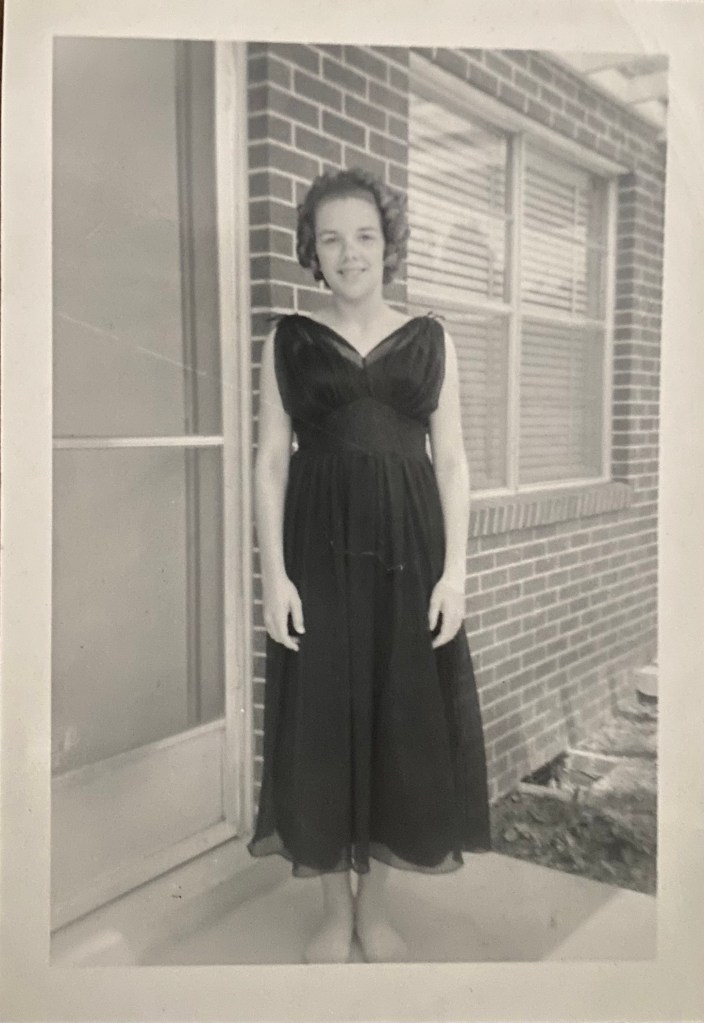
My mother was the one who helped me with my costume for the banquet. She gave me one of her negligees, black, with a lace bodice–which might have raised a few eyebrows. But I wore an opaque black slip underneath. And Mom spent more than an hour pinning my hair into tight pin-curls all over my head.
As I was leaving for the banquet, she snapped a photo of me standing barefoot on the stoop of the duplex. My hair, pulled back from my face, cascaded into a mass of ringlets. My pale arms draped long and graceful against the diaphanous black of my costume, and I smiled shyly at the camera.
Surely, the sweetest, least discordant Goddess of Discord you are ever likely to meet.
I won first prize.
That same Spring, one early evening in April, I was sitting on the living room floor, watching a TV show. Or maybe I was reading a book or doing homework–I don’t really remember. I know it was still light outside.
My father burst through the front door, lunged toward the TV, and flipped through the channels.
“Dad, what’s wrong?”
“Martin Luther King has been shot.”
(to be continued)

