This post is an excerpt from my memoir From Where I Stand, a story of love across time and race. The place is six miles to the west of Wake Forest, North Carolina. The time is 1968-1969. In 1971, Wake County schools were mandated to be fully desegregated.
The story follows on the heels of my previous post, “Goddess of Discord.”
Late in 1968, the search committee for Ridgecrest Baptist Church came to our home to interview my parents. The white congregation was looking for a pastor, and my dad, on the cusp of completing his Master of Divinity degree at Southeastern Baptist Theological Seminary in Wake Forest, NC, was looking for a church. Both he and my mother dreamed of settling in Wake Forest after Dad graduated from seminary and making our family’s home there.
I’m guessing the committee asked my father the kinds of questions Southern Baptist churches usually asked prospective pastors: His approach to theology, his religious beliefs. His views on pastoring, on leadership of the church, on Baptist principles of church autonomy.
The hot-button issue of “integration” came up at the end of the interview. Whether they raised it, or he did, I don’t know. But Dad told them in no uncertain terms that he supported the imminent desegregation of the schools. He added that he and my mother had come to believe that segregation was morally wrong.
Dad’s position on desegregation was hard won. Born in the early 1930s in southeastern Virginia, he and my mother had both grown up in the Jim Crow South. When my father first became a preacher, he was a segregationist as well as a fundamentalist.
The year that my dad was ordained, 1957, was the same year that the Southern Christian Leadership Conference was born. An organization of Black clergy and church officials committed to ending segregation, the SCLC became a central part of the civil rights movement under the leadership of Rev. Dr. Martin Luther King Jr.
As Dad listened to the preaching of Dr. King and witnessed the nonviolent protests of the civil rights movement, his world view was challenged and upset. He went to the Bible at first hoping to prove that Dr. King was wrong. Instead, his Biblical studies convicted him. He came to the conclusion that, “What is making me angry here is that Martin Luther King is just a better Christian than I am.”
In that moment, Dad recognized that he had reached a crossroads. He must either give up being a minister and a Christian, or do his best to follow what he was coming to understand as the true gospel of Jesus Christ.
I’m sure Dad shared this story with the committee. He may also have told them that, after Dr. King was assassinated, he had come to the conclusion, “If a man like that, who taught what he taught and lived the way he lived, can be murdered, then we’re not moving too fast. We’re moving too slow.” I know he said to them that he would not hesitate to invite his Black colleagues and friends from the seminary into our home for dinner.
As the door closed behind the search committee, my mother remarked drily, “Well, you can kiss that church goodbye. They’ll never call you now.”
No more than an hour later, the phone rang. It was the head of the committee, calling to offer my father the position of pastor of Ridgecrest Baptist Church.
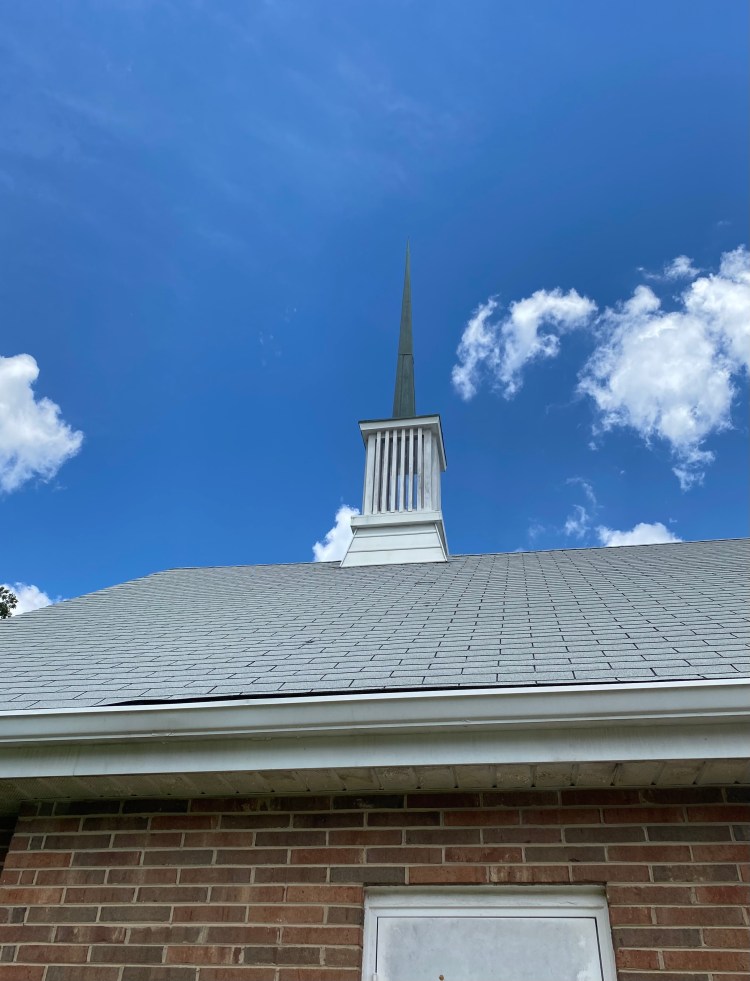
On March 23, 1969, my father was formally installed as pastor of Ridgecrest Baptist. The church was (and still is) six miles west of Wake Forest. Bigwigs from the seminary, including the president and the professor in charge of Church-Community Development, took part in the service. The Wake Weekly, our local paper, wrote a feature article and included my father’s photo.
The church was young, seven years old at the time. Its members were people who had lived in the area for generations, but in 1962, forty-two members had split from nearby Stony Hill Baptist Church, which had been built twenty years after the end of the Civil War.
Ridgecrest was established less than a mile away from Stony Hill, which meant that the two churches were forced to compete for members from among the same limited group of people. I haven’t been able to find out the reason for the split. But to build in such close proximity seems at the very least an unfriendly act.
Sandra Woodlief, my friend and classmate, was a member of our new church. Her family were part of the group that split with Stony Hill. And her father, Woodrow Woodlief, was Ridgecrest’s chair of deacons.
Early on, the deacons warned my dad not to go visiting in the area without an invitation. He was not to go knocking on doors or following any long dirt driveways, the way he had been accustomed to doing when he pastored other country churches. There were apocryphal stories about men who had gone up into the woods and never come out. Granted, most of those were revenuers. But no matter who you were, if you stumbled onto somebody’s property uninvited, you were likely to receive an unfriendly welcome in the area people called “the Harricans.”
The Harricans (pronounced HAIR-k’ns) was a location of indeterminate latitude and longitude. As one Wake County sheriff famously said, if you asked where the Harricans was, the answer was always “a few miles up the road.” The region got its name after a hurricane swept through and devastated the hardscrabble farming community trying to eke a living out of ungracious soil. Many folks gave up on farming and turned to the manufacture of moonshine—a.k.a. white lightnin’, corn licker. In a dry county, as Wake County was at the time, the Harricans’ claim to fame was that you could always be sure to find a Mason jar of something from a still out in the woods that would take the edge off your pain and the lining off your innards.
Among Black people, the Harricans had another, more sinister, reputation. It was known as Ku Klux Klan territory. Whenever possible, they avoided driving through the area after dark.
Most of the people who lived in the Harricans—maybe all—were white, as far as any of us could tell. Many were descendants of Confederate soldiers and proud of it. Some families gave their children the names of Confederate generals, like Nathan Bedford Forrest, or Stonewall, for Stonewall Jackson. The majority were dyed-in-the-wool segregationists.
When my father accepted the call to pastor Ridgecrest, he was not naive. The husband of one of Ridgecrest’s members said that, if his daughter were to date a “n****r,” he would “shoot them both down in the road like dogs.” And, in a seminary paper Dad wrote in the summer of 1969, he quoted the constitution of a nearby church: “If a n****r steps foot on our property, we will throw him off.” In later years, he told me the church was Stony Hill Baptist.
In the spring of 1969, Ridgecrest was struggling to stay afloat. In the past, plans for a new parsonage had been drawn up–and then shelved. There wasn’t enough money in the budget to build it.
After Dad became pastor, however, the church began to grow. Attendance was up. Offerings increased. The congregation was so pleased that they voted to build the parsonage that same summer.
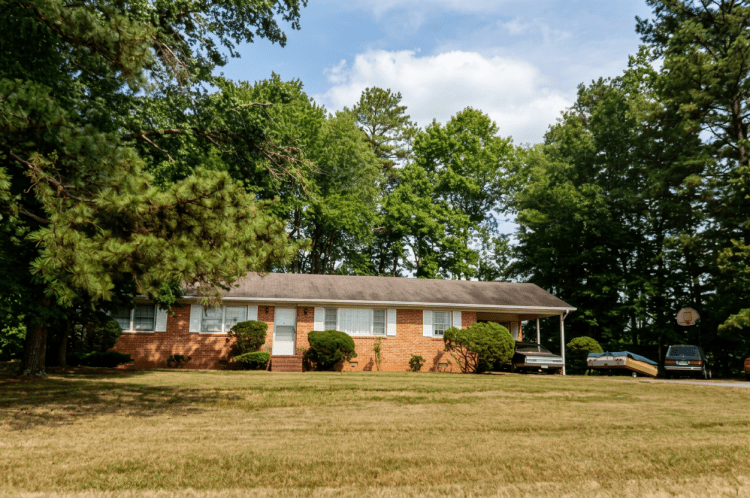
The parsonage that was to be our home sat back about 75 feet off Stony Hill Road. A modest red brick ranch-style house, it was just around the corner from the church. To the left as you faced it were the bedrooms. To the right, behind a wide picture window, was the living room and, beside it, the dining room. The front door sat roughly in the center. All the way down at the end was a covered carport.
Entering through the front hall, you passed the living room and straight into the family room directly behind it. About the same size as the living room, the family room featured a fireplace. On the back of the house, sliding glass doors opened into a shallow back yard, beyond which were dense woods.
The kitchen sat next to the family room, behind the dining room. A short hallway led to the laundry room and a pantry, and a door opened from the hallway onto the carport.
The church surprised my parents by installing, at extra cost, an automatic heat pump to regulate the temperature in the house. The fireplace was another surprise.
But the thing that made the deacons’ eyes light up, was the wood paneling that lined the walls of the family room.
“That paneling’s custom-made,” Mr. Woodlief told us. “If it gets messed up, it can’t be matched–the whole thing will have to be ripped out and replaced.”
They were extremely proud of that paneling.
Construction was completed by summer’s end, and in September we moved into the brand new parsonage and the Harricans.
My mother brought azalea cuttings from her mother’s house in Norfolk, Virginia. Every spring, my grandmother’s yard exploded with pink, red, fuchsia, purple, and white blooms. Thick bushes encircled the sweet-gum trees or stood alone in the backyard. They rivaled the azaleas in the Norfolk Botanical Garden.
Mom planted the cuttings along the edge of the woods behind the parsonage. They were the only thing she later regretted leaving behind.

