Bringing people together has always been a dangerous proposition.
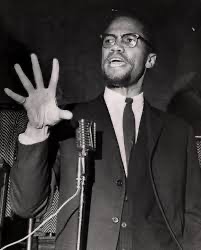
The man in the black and white photograph is looking to his right. The camera captures him from below, emphasizing his stature. His right hand is extended, the long fingers spread wide. Caught mid-speech, mid-sentence, mid-thought, he is intent on what he is saying. His narrow tie punctuates the seriousness in his face. His trimmed goatee is new, an addition from his recent pilgrimage to Mecca.
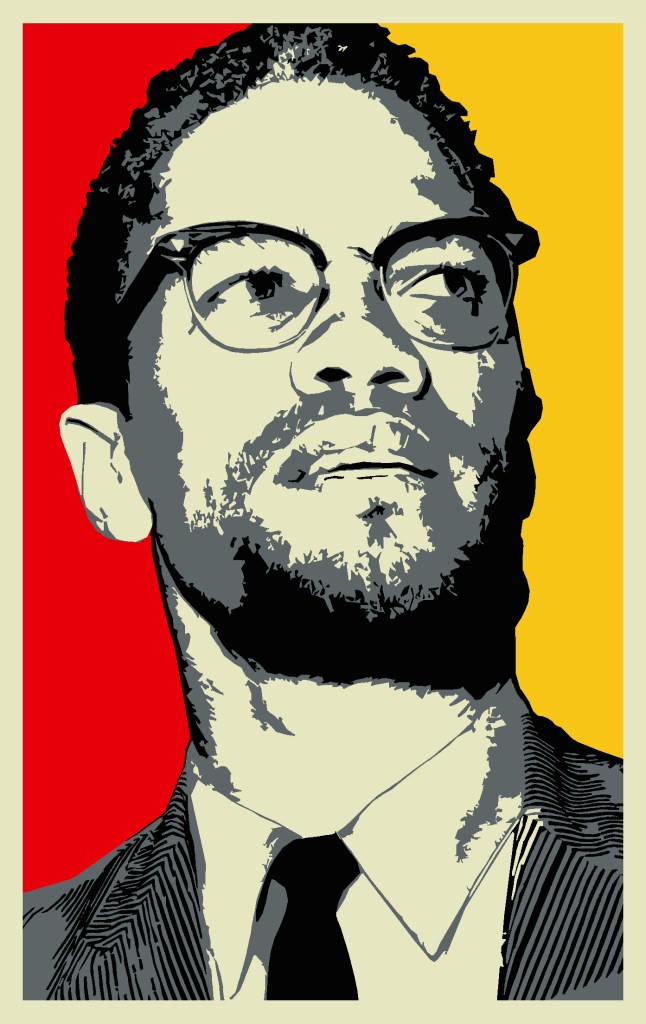
On May 19, 1925, Malcolm Little, the boy who grew up to become El-Hajj Malik El-Shabazz, was born. Today marks his 101st birthday. But, like many of our modern-day prophets, Malcolm X did not live past the age of 39. Celebrated and feared for his straight talk and uncompromising stand, he refused to soft-pedal the message, no matter how uncomfortable his words made people feel. And his words made a lot of people uncomfortable. Black folks as well as white folks.
In 1963, in an interview with Black journalist Louis Lomax, Minister Malcolm said, “Why would any black man want to marry a devil…for that’s just what the white man is.”
Lomax responded, “I have heard you say that a thousand times, but it always jolts me. Why do you call the white man a devil?”
“What do you want me to call him, a saint?” Malcolm X retorted. “Anybody who rapes, and plunders, and enslaves, and steals, and drops hell bombs on people…anybody who does these things is nothing but a devil.”
For the white man to ask the black man if he hates him is just like the rapist asking the raped, or the wolf asking the sheep, “Do you hate me?” The white man is in no moral position to accuse anyone else of hate!
Malcolm X
As a white woman–a woman who was raised and racialized as white–I will never know how it feels for Black people to hear his words. I can only bear witness, through film clips and audio recordings, to the enthusiasm his speeches inspired in the streets of Harlem.
But I do know how it feels to be on the receiving end. The white end. Even today, more than 60 years after his death, his razor-sharp observations can draw blood.
One way I gauge their power is by my own resistance, my knee-jerk compulsion to deflect and defend myself. Like white people have been doing for centuries.
In “The White Man’s Guilt,” James Baldwin wrote that most white Americans find themselves “impaled on their history like a butterfly on a pin and become incapable of seeing or changing themselves…. They are dimly, or vividly, aware that the history they have fed themselves is mainly a lie….”
No wonder so many white people do not want the full story of American history taught in schools. We are terrified of what we will find, what we will see and be forced to acknowledge–and what we may then bear the responsibility for working to change.
And let’s be honest, part of white people’s terror may be, as Baldwin also wrote, “…a carefully muffled fear that black people long to do to others what has been done to them.” Or, as Minister Malcolm might have put it, fear that the chickens are coming home to roost.
We are terrified of what we will find, what we will see and be forced to acknowledge–and what we may then bear the responsibility for working to change.
Listen–if I want to puncture the illusion of white supremacy, I don’t have to believe that a Black Meccan scientist created a race of white devils. All I have to do is to allow the truth of what was done–and is still being done–in the name of whiteness, to pierce my heart.
My father quoted someone—I cannot find the quotation or who said it—that “the white man had better learn how to love before the Black man learns how to hate.” With the burgeoning of the Black Muslim movement under Malcolm X’s leadership in the early 1960s, I can imagine it appeared to many white folks, like my father, that it might be too late.
“[Most white Americans] are dimly, or vividly, aware that the history they have fed themselves is mainly a lie….”
James Baldwin
But, after Minister Malcolm made his pilgrimage to Mecca in the spring of 1964, something inside him shifted.
The hajj (for anyone who is reading this and does not know) is one of the Five Pillars of Islam. It is a holy obligation for every adult Muslim who is physically and financially able to make the pilgrimage. But the hajj is not only an obligation. It is also a blessing.
During the hajj, Malcolm X saw some of his most deeply held beliefs about people with white skin challenged and changed by the “sincere hospitality and the practice of brotherhood as I have seen it here in Arabia.”
He wrote, “During the past days here in Mecca…I have eaten from the same plate, drank from the same glass and slept on the same bed or rug…with fellow Muslims whose skin was the whitest of white, whose eyes [were] the bluest of blue, and whose hair was the blondest of blond—I could look into their blue eyes and see that they regarded me as the same (Brothers), because their faith in One God (Allah) had actually removed ‘white’ from their mind….” (“A Letter from Mecca,” April 26, 1964).
I suspect that the transformation was not as sudden as it appears. Minister Malcolm hinted as much in the same letter: “This ‘adjustment to reality’ wasn’t [too] difficult for me to undergo, because despite my firm conviction in whatever I believe, I have always tried to keep an open mind, which is absolutely necessary to reflect the flexibility that must go hand in hand with anyone [whose] intelligent quest for truth never comes to an end.”
When Malcolm X arrived back in the U.S., Alex Haley, the author who wrote with him The Autobiography of Malcolm X, recorded an exchange between reporters and the newly-returned minister:
“Do we correctly understand that you now do not think that all whites are evil?”
“True, sir! My trip to Mecca has opened my eyes…. I have adjusted my thinking to the point where I believe that whites are human beings”—a significant pause—”as long as this is borne out by their humane attitude toward Negroes.”
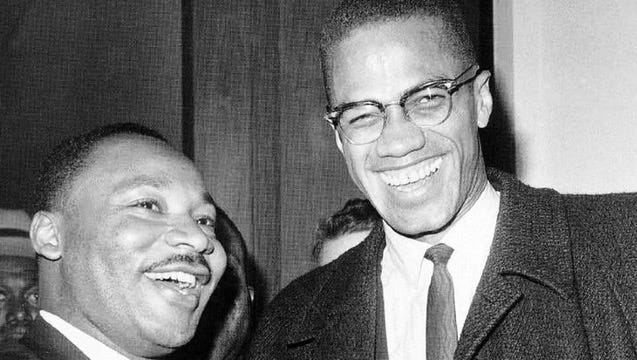
When I look at the timing of Malcolm X’s assassination; when I ponder the central role the U.S. was playing in international assassinations and coups throughout the 1960s and well into the 70s; when I consider that J. Edgar Hoover and the FBI had both Malcolm X and Dr. King in their sights, I am struck by the realization that Minister Malcolm was cut down at a time when he was talking about cultivating an open mind and working toward bringing people together, both within the boundaries of the United States and worldwide.
When I consider how the hajj prompted such a profound change in him, I have to ask myself: Was that the moment that tipped the balance for those who wanted him out of the way for good?
My point here is not to speculate about who might have been behind the hand that pulled the trigger when Malcolm X was gunned down in the Audubon Ballroom in Harlem in February of 1965. Others have written about the governmental agencies and other groups that aggravated and manipulated internal tensions and conflicts in the Nation of Islam to their own ends.
But this I know: Those who follow the guidance of the Eternal, whether it speaks to them from beyond or within the depths of their own hearts—call it God, call it Allah—those people are dangerous. For everyone. And reading Minister Malcolm’s writings and speeches after the hajj, witnessing the actions he took, there is no question in my mind that the Divine had a-hold of him, and he could do nothing else but follow the guidance that he received from the MOST HIGH.
Those who follow the guidance of the Eternal, whether it speaks to them from beyond or within the depths of their own hearts—call it God, call it Allah—those people are dangerous.
And so I remember and pay tribute to Malcolm X today, on the 101st anniversary of his birth.
At the end of his life, Allah was leading him to bring people together rather than divide them. He began to talk about working with Black leaders he had previously vilified. He reached beyond the narrow borders of the United States to the nations of Africa, bringing them together with those who had been kidnapped from Africa centuries before.
Bringing people together has always been a dangerous proposition. When people come together, those in power know that they don’t stand a chance.

