In honor of my mother for Mother’s Day, 2026.
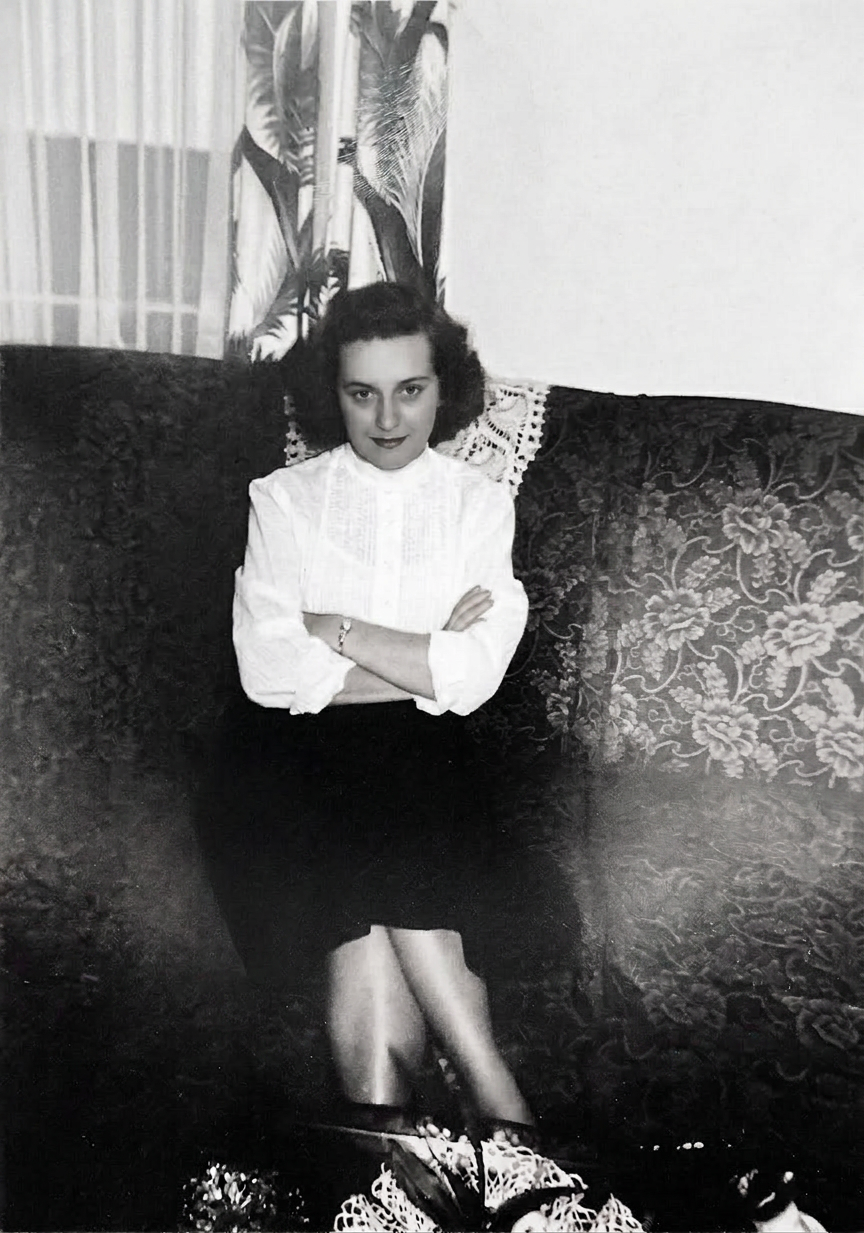
The photo is black and white, but I remember the deep wine red of the couch. I used to run my small fingers along the raised design of roses and leaves, tendrils and vines. But in this photo, my mother is a newlywed, and I would not be born for a year and a half.
Mom’s primary ambition as a young woman was to be a homemaker. She swore till the day she died that she had always wanted the house with the white picket fence. “Which is why I married a farmer,” she laughed. “I should have divorced your father for marrying me under false pretenses.”
It became a family joke.
In the photo, she sits with her arms and legs crossed. She raises her eyes and meets the camera lens with a steady gaze and a secretive, Mona Lisa-type smile. My mother was a shy woman who didn’t like to make noise. But in this photo there is something defiant in her gaze. Defiant, and triumphant. At eighteen years of age, she is a woman who has left her mother’s house and claimed her place in the world.
My parents’ first home together sat next to the Shipp family farm on West Neck Road in Princess Anne County, Virginia (now Virginia Beach). My dad’s grandfather started building the bungalow for them in 1951, and the wedding was planned for June, 1952, the month that the house was due to be completed. When Grandpa Murden told them that he was six months ahead of schedule, my parents pushed their wedding back to January.
The farm is gone, replaced by a shiny high school, but the house with the wine red couch is still standing. There have been extensions and cosmetic changes–the red brick, for example–but I recognize the central part where we lived.
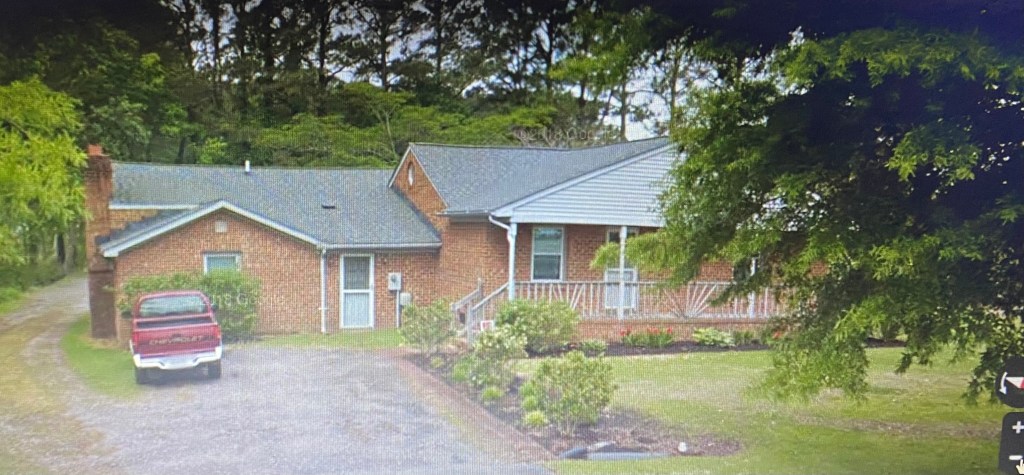
(Courtesy of Google Maps)
There was a Black man named Cleveland who worked for and with my dad on the farm. Dad and he were accustomed to stop at lunch time out in the fields, turn a box up on its end in the truck bed, and share some sandwiches my mom had sent out there with them. One day they ended up close to the house around midday, and Dad invited Cleveland in to join them at the table. Cleveland hesitated. In those days in the Jim Crow South, Black people and white people did not eat together at the same table. And sharing the same table with a young white woman could get a man lynched.
My dad said, “Listen, I’m not gonna go telling anybody about this.” Cleveland must have trusted him. From then on, whenever they ended up close to the house at lunch time, Cleveland joined them inside.
Fifty years later, my mother said, “It just didn’t make sense to me—if they were out there in the field, they’d be eating lunch together in the truck, wouldn’t they? So, why should that be any different if they came back up to the house?”
Make no mistake, my parents both accepted segregation and “separate, but equal” as the law of the society they lived in.
They were not rabid segregationists. They were not the ones burning crosses or spitting on Black students who desegregated all-white schools. They did not use the n-word. And it didn’t seem fair to my mother to leave Cleveland outside sitting on the stoop in the hot sun while they ate at the table.
But when Cleveland entered the house on West Neck Road, he came in through the back door. And they told no one. They were not about to challenge Jim Crow.
My mother was not destined to live long in that house. She thought she had married a farmer. Turned out she had married a minister of the gospel and a man of conscience. Not long after he was ordained in 1957, they left the farm.
In the same year as Dad’s ordination, the Southern Christian Leadership Conference (SCLC) was born. Rev. Dr. Martin Luther King Jr. was the SCLC’s first president, and it was the preaching of Dr. King that began to chip away at their acceptance of segregation. Within a few years, they became convinced that segregation was immoral, a conviction that shifted the trajectory of both my dad’s ministry and our family’s lives.

As a girl and young woman, I did not honor my mother’s courage. Her restraint stood in contrast to the outspokenness and passion I emulated in my father. She was not a crusader like him, never wanted to be the one out in front carrying the banner. But when my mom believed something to be God’s will, she could not be moved. Like a tree planted by the water, as the spiritual says, when she stood on principle, she stood firm.
While Dad attended college and seminary, we moved from one rental house to another, never staying in any one place longer than a year and a half or so. But as my father was completing seminary in Wake Forest, North Carolina, a small Southern Baptist church about six miles west of town called him as pastor. We moved into the parsonage the church built for us, and my parents looked forward to putting down roots.
Mom said years later that she had dreamed of seeing me and my brothers–ages 16, 14, and 9–all graduate from the same high school. She brought cuttings from my grandmother’s azalea bushes in Virginia and planted them behind the parsonage, along the edge of the woods.
But she didn’t live long in that house either. In the late 1960s–more than a decade after Brown v Board of Education–the schools of Wake Forest were being desegregated. My brother and I threw a party in 1969 that included our Black friends as well as our white friends. An hour into the party, someone fired a double-barreled twelve-gauge shotgun into the living room window, and double-aught buckshot tore into the heart of our home. By some miracle, no one was hurt or killed.
The church insisted that my father resign. When he refused, insisting that they go on record, they fired him and demanded that we move out of the parsonage as soon as possible.
Dad suggested to Mom that she take my brothers and me to Virginia to live with her mother.
“And where will you be?” she asked.
“Oh, I’ll be here finishing up my classes,” he answered.
“Oh no. I’m not going anywhere without you. If you’re staying, I’m staying.”
We moved into one half of what was known in Wake Forest as the old Powell mansion. The young white couple who owned the house risked their lives and reputations providing a home for us while Dad finished seminary.
While sifting through news clippings and letters that Mom collected over the years related to the shooting, I stumbled across the draft of a letter she wrote. It was addressed to The Voice, an independent newspaper edited by a Black friend of mine from Wake Forest High.
Written in the spring of 1970, the letter fills more than five typed, double-spaced pages. Edits and additions are scribbled in pencil, in the margins, between the lines.
It surprised me to discover that my mother had ever written anything. But what astonished me most was the power and conviction in her words.
“We have lived here in this town for over three and one half years…'” she wrote. “How many times were we told what outstandingly fine children we had? But somehow their acceptance of black friends and the events of the past several months have changed all this. Suddenly my son is stared at and talked about because he eats lunch with or sits at a ball game with a black teenage girl…. Statements like these come back to us: ‘That Shipp girl is such a pretty girl, it is a shame she is being ruined by sitting with all them n****rs.'”
She continued, “The real heartache has not come from strangers but from those we loved and trusted and thought loved us, those we thought were our friends but who, when the going got tough, turned away, some believing and even telling lies. We are deeply grateful for those few who did not turn away!”
She shared the story of how my youngest brother, 9 years old, had come to my parents’ bedroom one night when our father was out, unable to sleep. “I keep hearing loud booms,” he said, his eyes filling with tears. “I’m scared and all I can think of is, Daddy isn’t here and about the shooting.” She wrote that he prayed every night, “Please, God, keep Daddy safe and help him to protect us,” or “Help people who hate other people to stop hating and start loving other people like you do.”
She added, “Do you wonder why I must pray for the strength to love?”
Mom’s concern was not only for our family. “We are not the only ones in Wake Forest to live in fear. Why is this true in a town that has as many churches as Wake Forest? How can we call ourselves Christian?
“…I don’t wonder why some black men hate all white men. My real amazement and wonder comes [sic] from the realization that, after all they have suffered, some black men are still able to love and forgive white men. They far exceed my ability to love….”
My mom knew that our stand did not come without a price tag. “An attempt was made to murder us and it could be tried again,” she wrote. “One of these may succeed—people have been killed before for practicing Christian love and probably will be again—but let me go on record with this statement: We may be killed and thousands more like us, but the cause for which we stand—Christian love and equality for all men—will not be killed because this is God‘s will and therefore it is right! God will have the final word. It may not be in my lifetime or yours, but God will be triumphant!”
She closed by quoting the words of Dr. King: “I continue to pray for the day when a man will be judged by the content of his character, not the color of his skin.”
Clearly, Dad was not the only one in our family who could preach.
There were times over the years when my mother grieved over the house she would never own, over all the rental spaces she labored to make into homes.
“Just once,” she said, “I’d like to have furniture that matches.”
She cried as she said it. It was not a joke.
In every house, my dad once told me, there is what is called a load-bearing wall. “You can knock out any other wall you want,” he said, “but if you knock out a load-bearing wall, the whole thing’s liable to come crashing down on your head.”
My mother was like that load-bearing wall. She stood with my father and steadied him. She loved and supported all of us the best she could. Quietly, without fanfare, without calling attention to herself. Essential to the structure.
Maybe that’s why, to me and my brothers, home was never a geographical location. It was wherever our parents happened to be living at the time.
And only now do I realize: Home was wherever my mother lived, whatever house she tended. Whatever home she made.

