“An integrated party? In the Harricans?!“
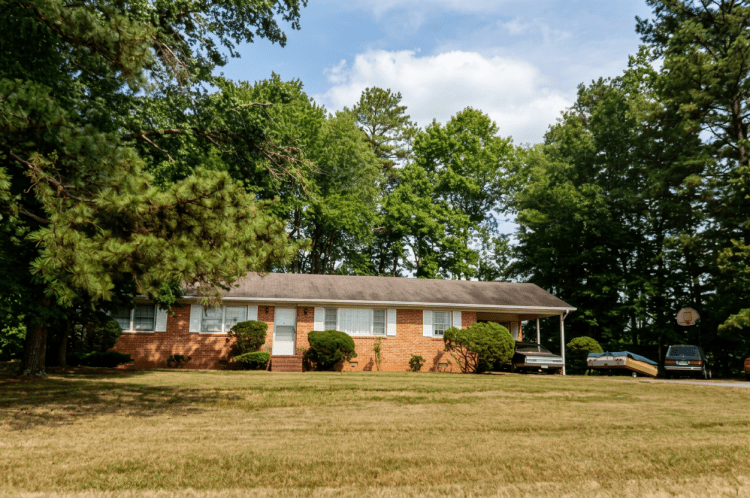
When his daughter Bettie told him that a white friend at school had invited her to a party out in the Harricans, Mr. Oney Edwards peered at her with a look that ran the gamut of incredulity.
The “Harricans” was a region out to the west of the small town of Wake Forest, NC. No one could pinpoint precisely where the Harricans was–the standard answer was “a few miles up the road”–but they sure enough found it when they went looking for moonshine in what was then a dry county.
Among Black folks, the Harricans also had another reputation: it was Ku Klux Klan territory.

Every year since 1967, when I entered high school, I had thrown a party for my friends. For my first two years at Wake Forest High, the schools in Wake County were still largely segregated. The church I attended, Wake Forest Baptist, was an all-white congregation. The dances I went to at the Wake Forest Community House were attended only by white teenagers.
All of my friends were white.
My world changed in the fall of 1969 when nine Black juniors transferred to predominantly white Wake Forest High from all-Black W.E.B. DuBois High School. The school year 1969-1970 was the last year of Freedom of Choice before full mandatory desegregation in 1970-1971.
DuBois teachers had identified these nine juniors as college-bound and urged them to transfer a year early. As Bettie told me years later, “They didn’t say it in so many words, but I think they knew it would give us a chance to acclimate to our new environment before senior year and graduation.”
It didn’t take long for me to make friends among my new classmates: Bettie Edwards, Pam Jones, Jean Williams, and Marjorie Gill, Mike Justice and Silas Jones.
And William Lucas.
The seminary duplex where we had been living since we moved to Wake Forest in 1966 was too small to accommodate all my friends. So, we would set the date for the party in the late summer or early Fall, while the weather was still warm enough to get outside and have a cookout.
But the new parsonage was plenty big. We could plan the party for whenever we wanted. And since my brother John had just started high school, this year his friends would also be included.
We planned the party for Saturday, December 13. Twelve days before Christmas, the decorations would take care of themselves. And we could light a fire in the new fireplace.
Even as a naive 16-year-old, I knew that white people in Wake Forest and the Harricans, including people at my dad’s church, were unhappy that we were inviting our Black friends to the party.
But I was idealistic. When white people grasped what Jesus had taught, I thought, they would naturally change their minds. Jesus had made it clear in the story of the Good Samaritan, hadn’t he, that the love he was talking about extended beyond race and color and nationality. So, if folks knew what Jesus was saying, wouldn’t they come around?
Yes, I was naive and idealistic–and stubborn, like both my parents. There was no way I would allow anyone else’s prejudice to make my choices for me. And on something as important as my Black and white friends having the freedom to gather in our home, I would not back down. If I believed what I said I believed, I had to live it, too.
Mom suggested that I show my friends a list of the names of everyone who was being invited. That way they could make an informed decision about whether or not they wanted to come. We were not trying to force integration on anyone.
It was not a protest we were planning. It was not a stand on a principle. It was a party. For our friends. In our home.
Did I show that list to all my friends, Black and white? I don’t remember. I’m betting I showed it only to my white friends, since they were the ones most likely to have an objection.
It was not a protest we were planning. It was not a stand on a principle. It was a party. For our friends. In our home.
At first, my white friends eagerly accepted the invitation. But one by one they changed their minds after I showed them the guest list. They stopped me in the hallway between classes, hit and run:
“I’m so sorry, but I’m not going to be able to come to your party after all. We’re going out-of-town that weekend.”
“I have to go Christmas shopping with my aunt that day.”
“Our relatives are coming to visit that weekend, and I need to be at home.”
The list of excuses was wide, but shallow. The actual reason was never spoken, but there was no genuine effort to disguise it. They were not gonna attend a party with them.
Some of my Black friends also decided not to come, but their reasons were notably different.
Bettie’s father, for example, had good reason to know what the Klan was capable of doing. A year earlier, one night after the family finished up eating supper, they heard an explosion down at the end of their driveway. The next day, they discovered that their mailbox had been dynamited.
“I didn’t have anything to do with putting my children on the school bus with white children,” Mr. Edwards told the reporters.
When Bettie asked to come to my party, he said, “An integrated party? In the Harricans?!”
And that was the end of that.
Only six of my friends ended up accepting the invitation: two white friends, Marjie Boal and John Steely, and four Black friends, Marjorie Gill, Silas Jones, Mike Justice, and William Lucas. None of my brother’s friends showed up.
Silas Jones later remembered a white girl at school asking him, “You going to that party?”
He told her yes.
“You might want to rethink that decision.”

