In memory of Dr. Barney Old Coyote Jr. (Apsáalooke/Crow)
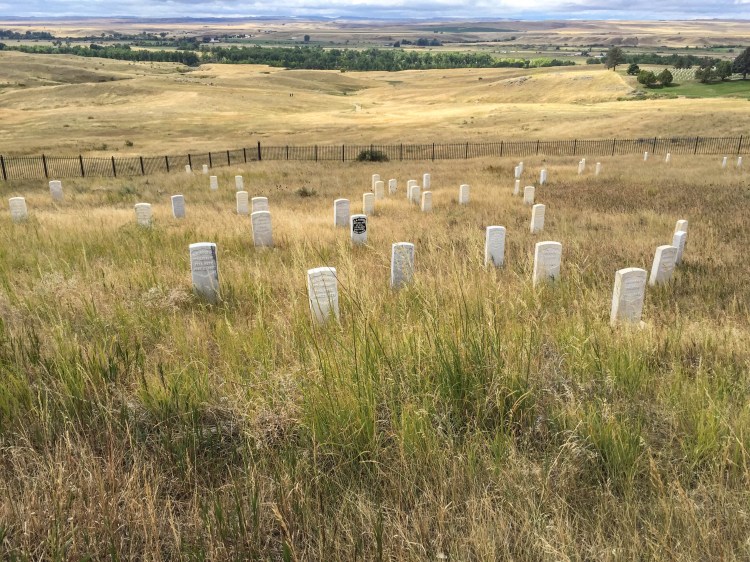
In the white history books that I grew up with, the battle was called Custer’s Last Stand. On June 25-26, 1876, we were taught, a large force of Indian warriors ambushed a much smaller troop of brave white U.S. soldiers and slaughtered them without mercy.
But in 1996 I began learning a different story.
The Little Bighorn Battlefield National Monument, previously known as Custer’s Battlefield, was renamed in 1991. The first two Indigenous people to serve as superintendents, Barbara Ann Sutteer (Ute/Cherokee) and her successor, Gerard Baker (Mandan/Hidatsa), fought for the name change against bitter opposition from Custer acolytes. They hired more Indigenous staff, despite the grumbling from disgruntled whites.
Then they went to work on the stories.
In 1876, Custer’s scouts, both of the Crow Nation, warned him that there was a large encampment along the Little Bighorn River. The Arapaho and the Northern Cheyenne had gathered there with the Lakota, including Sitting Bull and Crazy Horse, to consider what to do about the white men invading and settling on their lands, lands protected by treaty.
The current estimate of the size of the camp is 8,000, including women, children, and 1,500-2,000 warriors.
Custer’s total force numbered less than 700. And these he had split between three detachments.
The Crow scouts advised him not to attack the camp. In his arrogance, he ignored them.
The 225 soldiers under Custer’s direct command were ill-trained and inexperienced. Outnumbered and outmaneuvered, they panicked. Many of them died while firing their guns straight up into the air.
My parents and I circled through the battlefield, listening to a tour tape. The rolling hills of Montana sweltered in the August sun. And scattered among the long grasses were small chalk-white gravestones marking where the soldiers had fallen in frightened clusters.
We left the park and drove down below the steep bluffs and deep ravines to a modest museum tucked in next to a slough of the Little Bighorn River. The low white building stood at the site of Sitting Bull’s camp. The exhibits promised to tell more of the Indigenous side of the story.
We stepped into the cool lobby.
Behind the reception area stood a tall dignified man who introduced himself as Barney Old Coyote, an elder in the Absaroke (Apsáalooke/Crow) Nation. His daughter Rachel sat behind the desk.
“The Indian way of telling history is different from the European way,” Mr. Old Coyote said. “In the European way, everyone tells what they saw, and someone decides which story is the true story. Then that story becomes the history.
“But the Indian way of telling history is that everyone gathers in a circle. One person says, ‘From where I was standing, this is what I saw,’ and another says, ‘From where I was standing, this is what I saw.’ And all of those stories together is the history.”
All of those stories together is the history. Even if the individual stories contradict each other.
Who gets to tell the story?
Compared to what Mr. Old Coyote called “the Indian way,” it is clear that Western European history-telling is an exercise in power and domination. Think about it. Only the people in power get to say what the true story is.
And in their eyes, there can be only one true story. Everyone else’s story is erased.
No wonder the current administration has struck the stories of people of color from government websites. No wonder they demand that teachers stop teaching the stories of genocide and chattel slavery and Jim Crow, and no wonder they threaten teachers with punishment if they continue to tell the truth.
They say they fear for the self-esteem of white children. But what they really fear is that the stories will no longer center white people as heroes and saviors and victims. They fear for the future of whiteness and white supremacy.
This week is the 150th anniversary of the Battle of the Little Bighorn. The National Park Service (NPS), “in partnership with Tribal Nations, descendants, historians, elected officials, authors, military representatives, and cultural organizations,” plans to celebrate with presentations of descendants of both Indigenous warriors and cavalry soldiers. There will be special exhibits and cultural demonstrations. There will be drumming, youth and community programs, park ranger programs and battlefield interpretation.
The hope is that “the observance will provide opportunities for reflection, education, and cultural exchange.”
The visitor’s center has been closed to the public for a couple of years. Under construction. Now they say that the work will not be finished in time for the 150th anniversary.
I can’t help wondering—is it only the aging building that is being redone? Or are the exhibits that have begun telling the story from the Indigenous side of the river being reconstructed?
Ranger Sutteer never convinced the Custer Battlefield Historical and Museum Association to include “Bury My Heart at Wounded Knee” in the visitor’s center bookshop. They did not appreciate its sympathetic portrayal of the Lakota.
I guess we’ll have to wait and see what emerges after it reopens. But I’m not holding my breath.
Ahead of the NPS observance, Indigenous people have been gathering since June 17 on the land of Jim Real Bird, which straddles the boundary of the battlefield. His family have owned this land for generations. Every year for more than thirty years, Indigenous people have come together to camp along the Little Bighorn River (or the Greasy Grass, to the Lakota) and engage in a battle re-enactment. (I note that one of the websites reads, “No whites riding as braves!”)
For the 150th anniversary, they expect more than 500 horses and riders to participate.
This year, Indigenous leaders will also place a marker on Real Bird’s land. It will tell the story of a small group of Cheyenne and Lakota warriors who prevented the 7th Cavalry from crossing the river and attacking a camp full of women and children. At the top of the marker will be the words, “Thus Far and No Farther.”
The quote is taken from Custer’s book, “My Life On the Plains.”
Oh, the irony.
“From where I was standing, this is what I saw.”
White people in power think that they can determine what is history and what is not.
They mow down whole swaths of history and turn it into mulch, thinking that will be the end of it.
But that mulch holds the seeds of all the stories that have ever been told. Stories around campfires on the banks of the river. Stories in the basements of churches where HBCUs were born. Stories in novels and essays—and, yes, even some history books. Stories that are being told right here and on Substack.
We need to keep telling our stories.
Because history is incomplete until all of our stories are told.
And because no one else can see what I saw from where I was standing.
Note: Rachel Sue Old Coyote confirmed in private conversation my memory of her father’s words.
In memory of Dr. Barney Old Coyote Jr. (Chiipkalishtahchiash/Small White Buffalo Bull) (1923-2012). For more about his life, visit this link.

