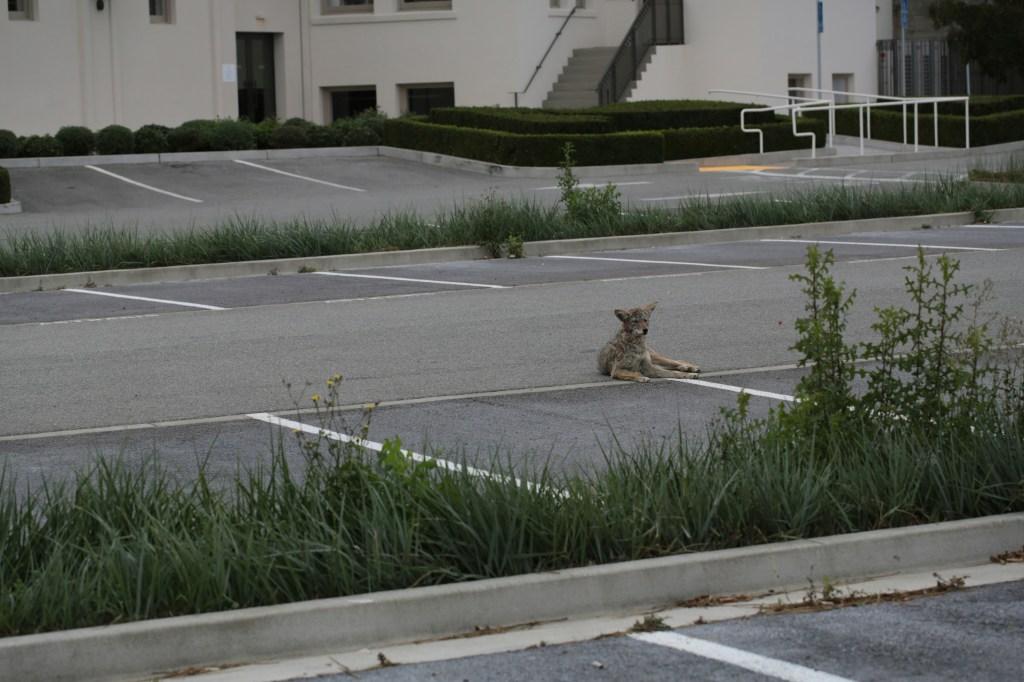
He darted out of the construction site to my right into the middle of early-evening traffic. A large dog running wild. The SUV ahead of me swerved and braked, but nipped him in the back legs. The dog spun in circles, coming to rest in the middle of the left-turn lane for oncoming traffic.
I swung into a wide U-turn and came up behind the animal, turning on my flashers, putting the car in park and leaving the headlights on. I got out. I have no idea what I thought I was gonna do.
I could hear my dad: A wounded animal is frightened. And dangerous.
His eyes narrowed, but he watched my slow approach without particular interest, alert but at ease. As if he had plopped down in the middle of a busy eight-lane boulevard to take a breather.
I squatted down. Slowly. We looked each other in the eye as I reached my hand toward his flank. Slowly, slowly. I murmured, I don’t know what to do for you, I don’t know what to do….
My mind cataloged what I was seeing: Gray-brown fur, matted and coarse, no collar, clearly living outdoors for a while. No blood. Tail thick and bushy, head shaped like a fox. Too large to be a fox.
My fingers brushed his fur, while he looked at me as if from a distance.
I don’t know what to do for you, I don’t know what to do….
Cars were lining up behind mine in the left-turn lane. I stood and walked back to tell the driver of the first car what was going on.
Is he alive? the man said.
Yes.
Well, let’s take a look.
But as we turned, the animal flashed to his feet and raced back the way he had come. Then he swung into a large circle and dashed back across eight lanes of busy traffic. Threading the cars with grace, he disappeared into the trees behind a church.
The man laughed. That was no dog. That was a coyote. Good thing we didn’t try to pick him up.
My heart thrummed all the way home. I touched a coyote. I touched a coyote.
Ten years later I can still remember the feel of his fur, the look in his eyes.
I grew up in the white Southern Baptist Church of the 1950s and early 1960s, but as a child I had my own private cosmology. I called the mountains Mother of Sorrows, and the ocean Grandfather. I thought of rocks as living beings. I sat beside trees for hours, cradled in their elephantine roots, and listened to birds and four-legged animals – spoke to them too. I felt certain they were trying to tell me something, although I couldn’t understand a word.
At age 16 in the Blue Ridge Mountains, I made my cautious way over moss-covered rocks to the middle of the branch of a river. The icy current, stronger than I’d expected, raced between my knees and threatened to pull me down. But I managed to stay upright, and I turned to face downstream and sang to the setting sun.
And because I knew there was no framework for any of this in the Christian religion, which gave human beings “dominion over the fish of the sea and the birds of the air,” I said nothing to anyone.
But as a 40-year-old woman, I visited the Black Hills of South Dakota in the summer of 1993. There I encountered a spiritual tradition that spoke the language I had thought was mine alone. It was the tradition of the Lakota Oyate.
And that’s where I first heard about Coyote.
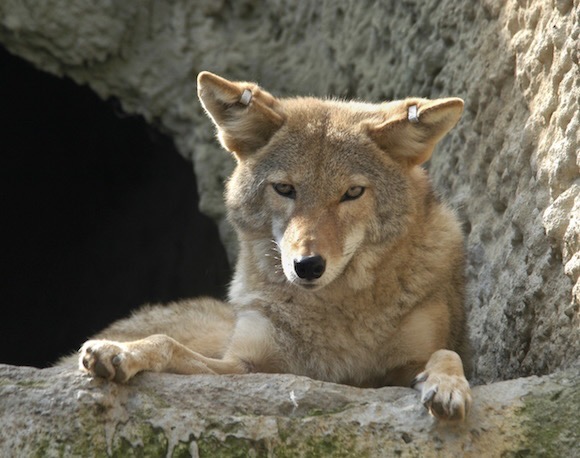
The Lakota (or “Sioux” as their enemies called them) recognize Coyote as the Trickster. He is met at crossroads and thresholds. He resides at the edges of things and on the periphery. Willful and clever – though not nearly as clever as he thinks – Coyote gets into trouble all the time in Lakota stories, overreaching, pushing the limit. A thief and a liar, he is at the same time susceptible to others’ lies. Coyote scorns the rules and scoffs at the instruction of others. And he often pays harsh penalties for ignoring good advice.
But Coyote is also the one who knows how to steal the bait and spring the trap without being caught. He covers his tracks, circling back behind his trackers again and again to throw them off his trail. And his superpower is adaptability. He susses out changing environments and new dangers, learns how to make his way across dangerous ground.
In his book Trickster Makes This World, Lewis Hyde writes, “…in the old days sheep farmers tried to get rid of wolves and coyotes by putting out animal carcasses laced with strychnine. The wolves, they say, were killed in great numbers, but the coyotes wised up and avoided these traps.” (p. 21)
Not only do they learn to avoid traps, coyotes have been known to dig them up, turn them over, and piss or shit on them, the naturalist Francois Leydet writes in The Coyote (quoted in Hyde, p. 21). And coyote hunters have written page after page about how to call a coyote using whistles that imitate animal cries for help – followed closely by a warning that experienced coyotes soon learn the difference between rabbit-in-distress and human-with-rifle.
Coyote is a complex, ambiguous character. And he knows how to survive.
There was no room for a Trickster in the Baptist churches I grew up in. The God I was raised to worship had strict rules – and the Ten Commandments were just the beginning. A thing was right, or it was wrong. A person was good, or they were bad. You obeyed, or you didn’t. And disobedience was sin. Cut and dried, black and white. No gray area.

The only coyote I knew anything about was the star of Saturday morning’s Road Runner cartoon. If you are as old as I am, you may remember it: Wile E. Coyote is forever trying to catch the Road Runner, a bird of superior intelligence. But the Road Runner outwits him every single time.
Cartoons were for Saturday mornings, but as the daughter of a Southern Baptist preacher, Sunday church was central to my childhood. I took to heart Jesus’ parable about the wise man who built his house on the rock and the foolish man who built on sand. Spoiler alert: the house on the rock withstands the storm, but the one on sand collapses.
And the Rock was Jesus! “On Christ the solid rock I stand,” we sang on Sunday mornings. “All other ground is sinking sand….”
How could there be a Trickster in that tradition! The Trickster makes his home on the shifting sand of ambiguity. He ain’t above lying, cheating or stealing to get what he wants. Driven by appetite, he is – by Christian standards – an unsavory character, to say the least.
But the Trickster can remind us not to take ourselves so seriously. We can laugh at his foolish antics, especially when he becomes the butt of someone else’s joke.
And because Coyote is not constrained to one “right” way of doing things, he is flexible. He demonstrates that when we don’t do something the way it has always been done – the way that is recommended or considered right (or righteous) – we might discover a way that is new.
After returning from the Black Hills to New York City where I lived at the time, I became enamored of all things having to do with the Lakota. I listened to the flute music of Kevin Locke. I visited the Native American Museum and ran my fingers through the coarse hair of a bison hide. I wept in front of the enclosed glass case that displayed Crazy Horse’s shirt. I read books and devoured documentaries.
In one of those documentaries, two white anthropologists told stories about Coyote around a campfire – a set-up which struck me even then as pretentious. But one of them said something that stuck with me. He pointed out that growing up with stories about the Trickster could be good preparation for navigating a world that doesn’t play by the rules.
Growing up with stories about the Trickster could be good preparation for navigating a world that doesn’t play by the rules.
Everything the Baptist church taught me promised that life made sense. Good people who followed the rules were rewarded, bad people punished. If I did the right thing, if I were a good girl, everything would turn out fine. I would be successful. I would be loved and praised. My life would move from actions to consequences in straight, well-ordered lines.
Which means that I grew up flabbergasted by a world where choices do not always fall into clear categories. The “right thing” may not be apparent. Besides, changing circumstances can turn a past “right” into a present “wrong.” And hatred and prejudice and injustice do not easily yield to the truth or even the facts.
I found myself unprepared to live in the world as it is.
Case in point: the day I looked into the eyes of the coyote was two days after the 2016 Presidential election. Like many white people, I was caught flat-footed, unprepared for an unprincipled shyster to end up in the seat behind the desk in the Oval Office. I felt like the earth had jumped its track around the sun.
Now the shyster is back. And things some of us imagined were rock-solid are being ripped from their foundations, collapsing in the face of unbridled “will to power” and greed, while the people we trusted to stop him and his cronies stand aside, proving themselves to be spineless, inept, or powerless to navigate the present moment.
Which leaves me – where? I wonder if growing up with stories about Coyote would have helped me right about now. Would the world’s insanity be less likely to throw me off course?
For most of my life, I put my faith in those straight, well-ordered lines. But Coyote doesn’t deal in straight lines, he moves in circles! He demonstrates that there is no well-ordered path that won’t be disrupted, there is no creation without destruction –
And perhaps that is our hope? that destruction will clear a place for the creation of something new?
In any case, my dears, Coyote is anything but a cartoon.
Was it an accident that Coyote crossed my path that night? In the metro area of Atlanta where I was living and working at the time, as well as in the place I am living now, constant construction is destroying Coyote’s home, pushing him into the backyards of suburban neighborhoods. And although he is remarkably adaptive, it is inevitable that at some point he will try to cross a road at a busy intersection and be hit – while the federal government cuts down every law that protects coyotes or any other wild creature.
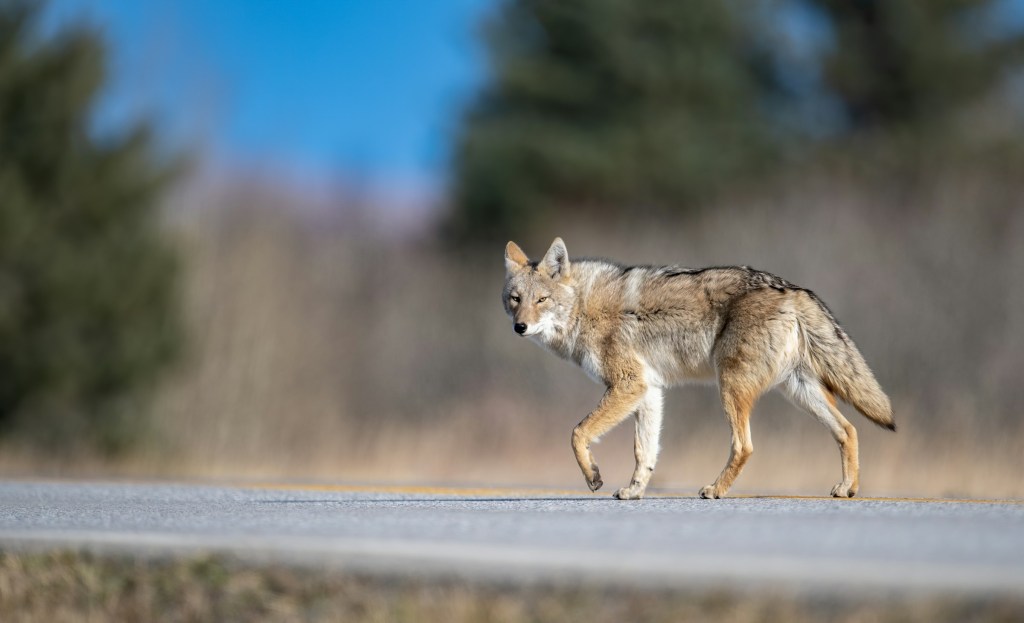
Still, Coyote surprises us, leaps up, backtracks, circles around and continues on the way he was going. He models for us how to be flexible, resilient, how to maneuver in times of upheaval, how to find our way through ambiguity.
And if we pay attention, maybe Coyote can teach us how to navigate this increasingly chaotic and tricky world.
I learned while writing this post of the passing of Kevin Locke “Tokeheya Inajin” (1954-2022). Lakota and Anishnabe, he was “a world famous visionary Hoop Dancer, preeminent player of the Indigenous Northern Plains flute, traditional storyteller, cultural ambassador, recording artist and educator.”
Kevin dedicated his life’s work to Baha’u’llah.
May his memory be a blessing. Mitakuye oyas’in.

