An excerpt from my memoir The Edge of All the Light You Have.
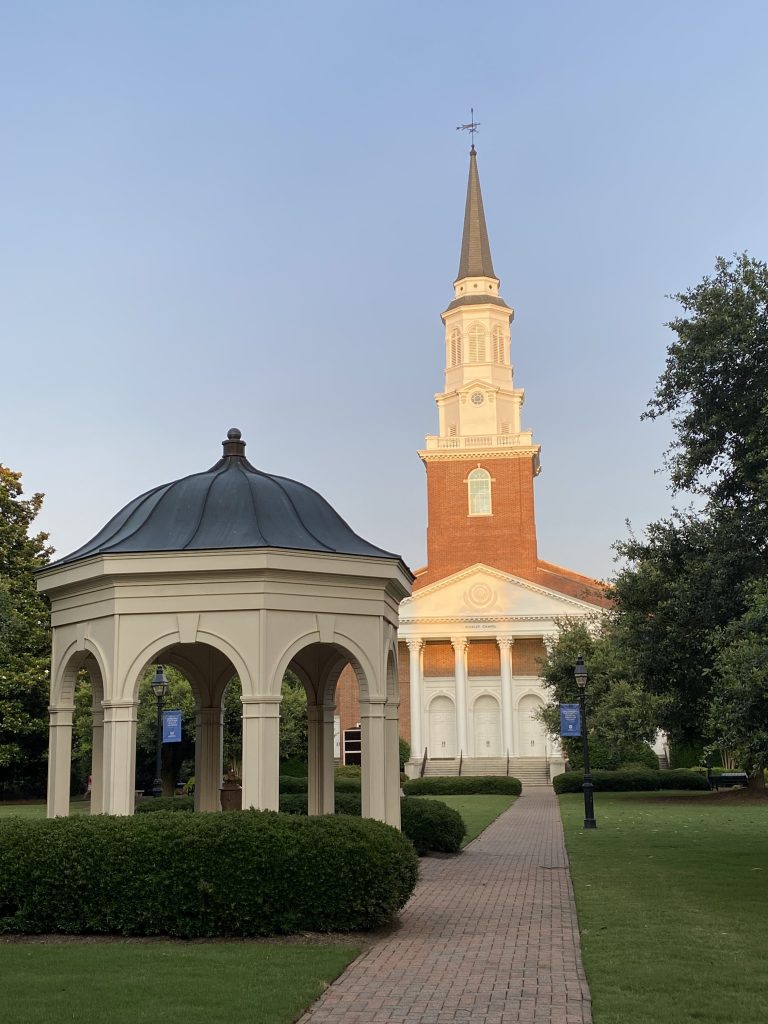
My family moved to Wake Forest, North Carolina, in 1966 so that my dad could attend seminary there.
The small town clustered around the campus of Southeastern Baptist Theological Seminary. The seminary sat dead center, and what little traffic there was flowed around it, like water around a boulder. Streets radiated out from the campus like tributaries. To the north was North Main Street, a boulevard with a tree-lined median, along which were built many of the oldest and grandest houses in town. To the east, Roosevelt Avenue crossed under a railroad bridge and took you to the downtown area. The homes along South Main were more modest than on North Main, although many were just as large and old. And to the west, Durham Road, the old NC Highway 98, took you out into the country.
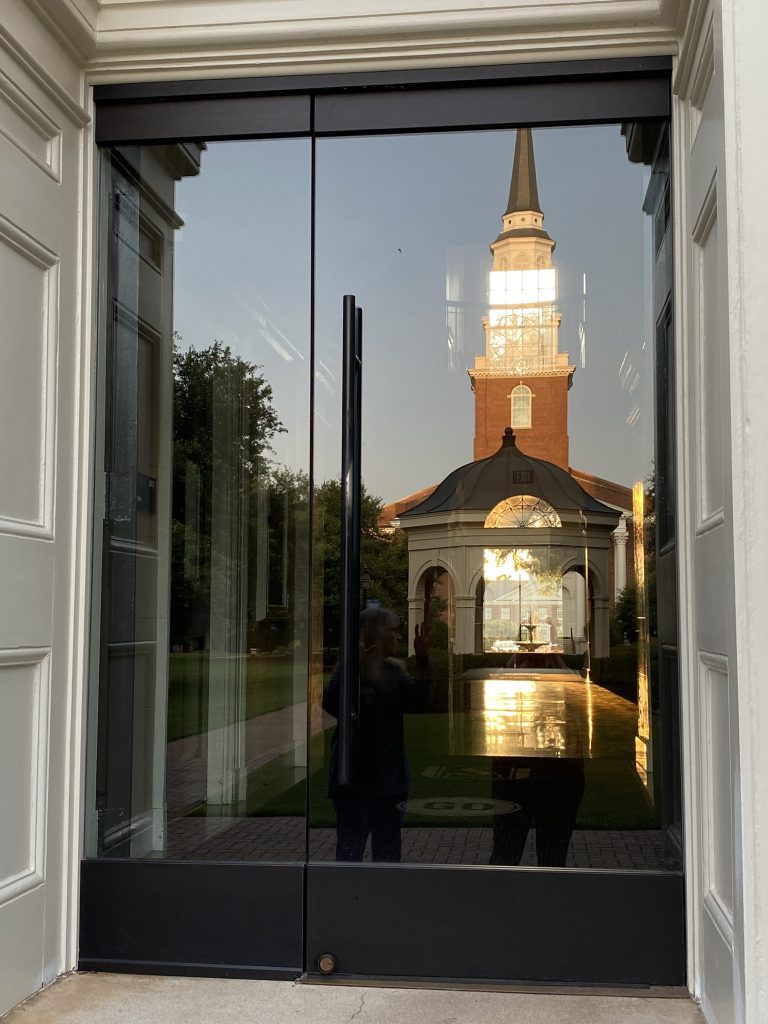
The seminary grounds were once the home of Wake Forest College, established in 1834. Large areas of green space, criss-crossed by brick walkways, meandered among towering magnolias and ancient-looking trees whose names I never learned. The buildings were two-story, red brick with white columns. The fragrance of boxwood hedges encircled the campus. The effect was welcoming and gracious.
On the southern edge of campus sat Wake Forest Baptist Church, a stately domed building dating back to 1915. And inside many of the buildings, the letters WFC in mosaic on the floor were a reminder of the campus’ past before the seminary was established in 1956.
“Your mother and I had hopes of staying in Wake Forest, of putting down roots,” Dad confessed in later years.
“I always preferred the small-town atmosphere,” Mom added. “It was so much more like what I grew up with. The sense of community….” She paused and looked away. “I hoped to see all three of you children grow up in the same place and have friends, graduate from the same high school—” Her voice caught.
In the ten years before we moved to Wake Forest, our lives were relentlessly itinerant. But it wasn’t always that way.
When I was born in the early 1950s, my daddy was a farmer. Daddy’s family, the Shipps, had a long history of farming in southeastern Virginia, stretching all the way back to the 1600s. Daddy and everybody else had every expectation that he would be a farmer to the end of his life.
The only person who suggested otherwise was Grandma Reid. “Why don’t you name him John Wesley?” she said when he was born. “Maybe he’ll be a preacher.” She embroidered JOHN WESLEY SHIPP in big block letters in the corner of the quilt she made for him.
My daddy spent his growing-up years on the family farm in Princess Anne County. The City of Virginia Beach swallowed up the county in 1963, but we always called the area Princess Anne. My parents, high school sweethearts, married in 1952, ages 18 and 19. After a short honeymoon trip to Florida, they settled into a bungalow built for them by my daddy’s grandfather. Their new home sat on the other side of a field from the house Daddy grew up in — the house I knew as MaMaw and Granddaddy’s house.
MaMaw and Granddaddy’s house sat well back off West Neck Road behind a deep ditch and two towering oaks, a hop, skip and a jump from the old Princess Anne County Courthouse. Two stories and cedar-shingled, the house was surrounded by the fields that Daddy and Granddaddy worked from before I was born. A windowless shed, more like a log cabin, sat beside the house. That’s where MaMaw kept the Rawleigh Products she sold. Her big yellow school bus—the one she drove for the elementary school across from the courthouse—was parked over to one side of the yard. Above it, spindly pines swept the sky in wide-swinging strokes when the wind blew.
Out back, behind a barbed-wire fence and a large swinging gate, was a shed for smoking meats and a barn where they kept a few chickens and harvested the eggs. That’s also where Uncle Rennie, MaMaw’s brother, boarded his ponies during the week.
Daddy and Granddaddy were truck farmers, growing fields of single crops—cucumbers, as I remember—to be trucked to local markets. They also raised hogs. There’s a photo of me as a toddler sitting on the hood of a truck that holds a load of hogs in the back. To supplement the farm income, Daddy worked part-time as a deputy sheriff and even ran for local public office. I have one of the post cards he handed out to people when he was campaigning.
My momma’s parents, the Bryants, were the city people in our family, or at least that’s the way I thought of them. Her daddy owned an appliance store in downtown Norfolk. And her momma worked as his bookkeeper. Grandmommie and PawPaw lived in Norfolk, on a quiet, elegant street in a neighborhood known as Ocean View.
Momma was their only child. Her birth was nearly the death of both her and Grandmommie, when she could not squeeze through the narrow birth canal. The doctors had to pull her out with forceps, prompting my Aunt Grace, a nurse, to flee the operating room. “I never saw a child born with forceps who didn’t come out in pieces,” she said.
Mother and baby survived, but I’m betting that Grandmommie and PawPaw never attempted to have a second child.
My momma’s first cousins were as close to her as siblings, but, when they were not around, she was alone. She dreamed of having a house full of children. She didn’t want any child of hers to grow up as lonely as she did.
Four children was the number she settled on. Daddy wanted two. They compromised on three.
I came first. My brother John followed 18 months later. My youngest brother Bryant was born in 1960 — by then our lives had completely changed.
But the farm on West Neck Road is where I spent the first almost four years of my life, firm-rooted in the soil of my paternal ancestors.
Until my daddy became a preacher.
Daddy first felt the call to “the gospel ministry” when I was about two and a half years old, and my brother John was an infant.
Rev. Joiner asked him to be Youth Pastor for a week. His responsibilities were to preach a Sunday night sermon, lead a midweek prayer meeting, and preach again the following Sunday morning. As he stood in the pulpit on the second Sunday, the strangest feeling came over him.
He told me later, “I suddenly felt, This is where I am supposed to be. But then I thought, Oh Wes, you just like being the center of attention, that’s all!”
He talked it over with my momma — they made every decision that way. Every night, he made a plan to call the pastor first thing in the morning. And every morning, he said to himself, Wesley, that is the dumbest idea you ever had. Then he dressed and went over to the main house. He and Granddaddy planned the day’s work over breakfast, and Daddy headed back out into the fields.
He started having sharp attacks of abdominal pain. The doctors couldn’t explain it. At first, they thought it was his gallbladder. They ran repeated tests, and every test came back negative. There was nothing wrong with him. Physically.
But the pain was debilitating. Daddy couldn’t eat much of anything, and if he ate, he couldn’t keep it down. Within a year and a half, he had wasted away to a shadow of himself. The photos from that time show a man whose cheeks are sunken in. He is never smiling. He looks haunted.
The family worried that he would die.
One night, he said to my momma, “You know, I have this feeling that, if we pray about it, everything is gonna be all right.” So, that’s what they did. They knelt on opposite sides of the bed and held hands across the mattress.
The following morning he made an appointment with the pastor. He told Rev. Joiner about the attacks. He described the physical and emotional state he was in. “What do you think I should do?”
Joiner paused. “Well, here’s what I think: If you can do anything else and be happy — anything at all — then go and do that and forget about becoming a minister.”
Daddy chuckled and shook his head. “I already tried that, and it’s damn near killed me.”
“Well, then. You have your answer.”
The following Sunday my parents walked together, hand-in-hand, down the church aisle and dedicated themselves to what Baptists called “the full-time gospel ministry.”
Rev. Joiner cautioned him, “I want you to be absolutely sure in this moment that God is calling you. Because the day will come when you will doubt everything — will doubt even that you were called to begin with. I want you to be able to look back and remember this moment.”
In later years, my father wrote that accepting the call to the ministry was “traumatic.” He knew even then that our lives were set to change, although neither of my parents had any idea the repercussions of their decision.
But once Daddy accepted his call, the attacks stopped happening as mysteriously as they had begun.
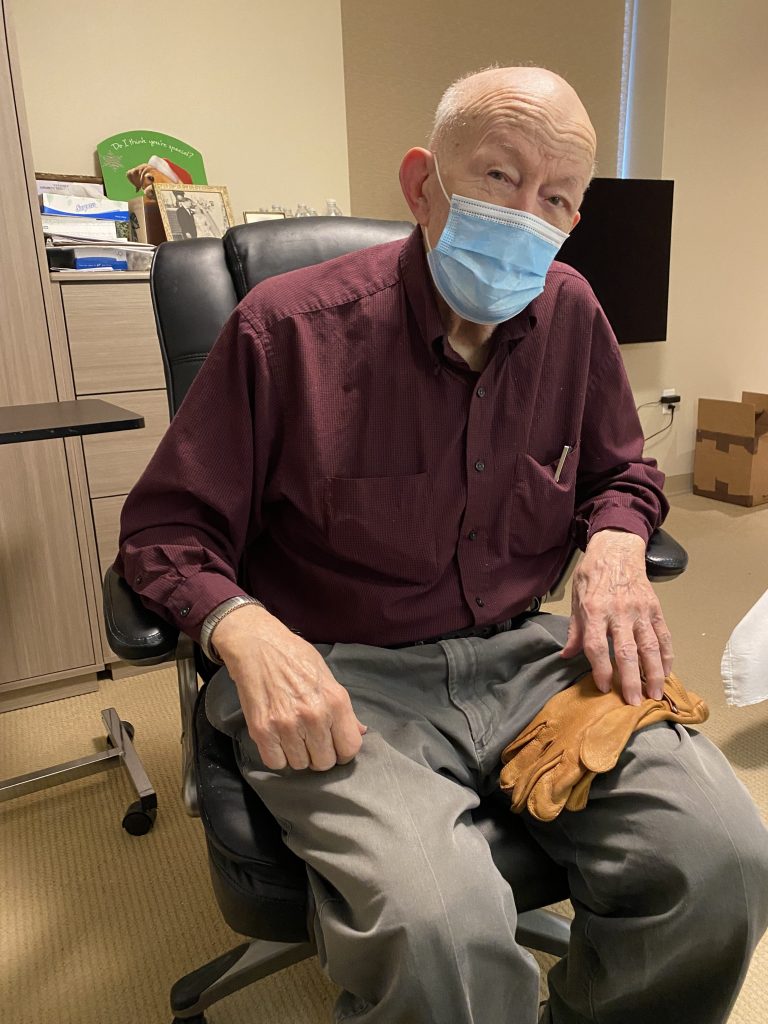
I tell the story of my daddy’s call to the ministry because my brothers and I grew up hearing it all our lives. Part of our family mythology, you could say. What I learned from it is that God’s call is serious business, and you ignore it at your own peril. Of course, accepting the call might put you in the path of even greater peril, as we learned later. But when God calls you, it means that They — I think of God as non-binary — want more from you than eating and breathing and taking up space. God intends you for a higher purpose, some unfinished business of Their own.
My momma swore until the day she died that, as a young woman, she had really wanted the proverbial little house with the white picket fence. “Which is why I married a farmer.”
She laughed. “I should have divorced your father for marrying me under false pretenses.”
After daddy was ordained, we left the farm on West Neck Road. From that day on, for the next ten years, we moved. A lot. From one rental house to another, from one neighborhood to the next.
Moving as much as we did, I learned how to make friends easily. And I learned how to let go of them just as easily when we moved. No place was permanent, and there was no point in becoming attached.
And anyway, I liked the freedom of moving around, I told myself. I thought of my family as nomads. MaMaw and Granddaddy’s farm in Princess Anne and Grandmommie and PawPaw’s house in Norfolk were all the home I needed.
After my brothers and I had grown up and left for college, the family joke was that our home was wherever our parents happened to be living at the time. We made a parody of the old television sign-off, substituting the word parents for children: “It’s 11 o’clock. Do you know where your parents are?” We bragged about being rootless.
If I’m honest, though, I did wonder sometimes what it would be like to grow up with the same old friends in the same old neighborhood, sharing memories and private jokes. It might be nice to live in a place where I knew I belonged.