“Look back, but don’t stare,” my dear friend Barbara Fisher said to me. She was accompanying me in the laborious and sometimes painful process of settling accounts with my past, cleaning up some of the mess I’d made of my life. The important thing, she told me, was to see and acknowledge where I had been wrong, to take any action that was called for, and then to let it go.
“It is the unhealthy tree that cannot shed its leaves,” she told me. I took the metaphor to heart.
But the truth is more complex as I have since learned. Even mysterious. At least for trees.
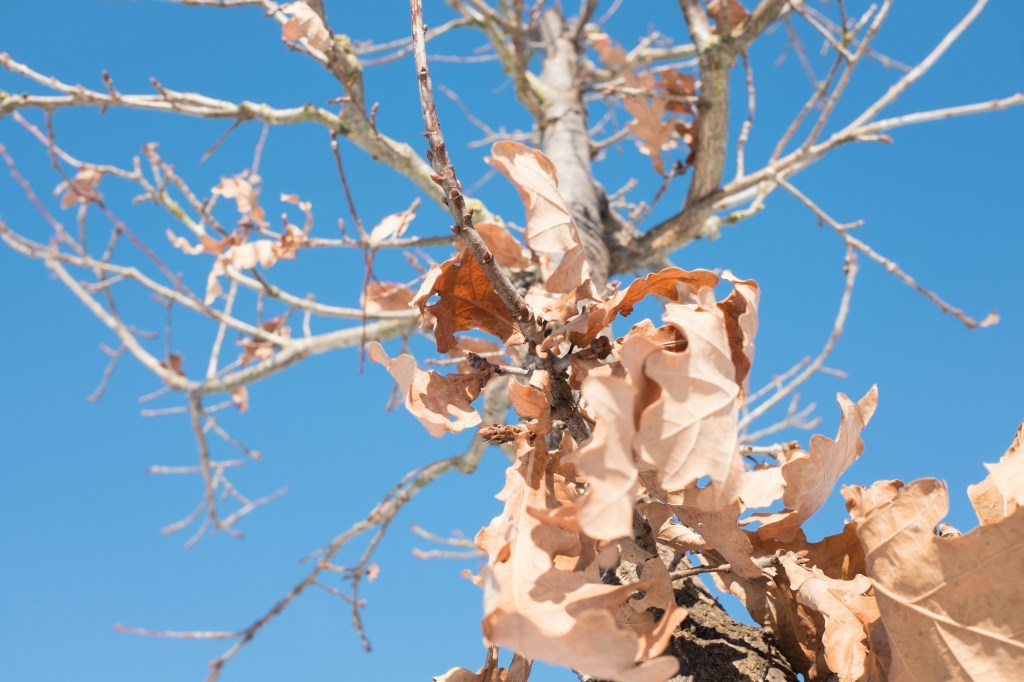
Certain hardwood trees, like beeches and oaks, hang on to their withered leaves through the winter, dropping them in spring. Scientists have named the process marcescence, from the Latin verb marcescere, meaning “to fade.” (I threw that last bit in for those of you who, like me, are nerds about words.)
But while they have a name for it, scientists can only speculate as to why it happens. Maybe the leaves provide a fresh layer of mulch to nurture spring growth. Maybe the dead leaves provide some shelter for wintering birds. Maybe they protect new buds from browsing grazers, like deer. (Dry leaves taste nasty, or so they say. I can’t help wondering how they know.)
So, marcescence isn’t a sign of ill health. It is just what some deciduous trees do. For reasons unknown to us, reasons they keep to themselves.
When to let go. When to hang on.
How do they know.
It is the end of October. Here in the Northern Hemisphere, the days grow short. The darkness deepens and widens. Life draws inward. The Earth goes into hibernation with the bears.
We are entering what ancient Celts might call the “time between times,” which will not come to an end until the Winter Solstice on December 21 (or thereabouts) and the return of the sun.
The roughly fifty days between Hallowe’en and Solstice is a thin time, when the veil between the living and the dead becomes permeable. It is time to honor (or reckon with) the ancestors. Both the ones who share my DNA and the ones who are my spiritual forebears.
Every year about this time, I think of Barbara Fisher. Not only on All Hallows’ Eve, but on November 6, which was her birthday. A double Scorpio, as she liked to say. A woman of unsounded depths.
And there truly were depths to her that I suspect no one ever sounded. Growing up as the daughter of Jewish immigrants from Ukraine in Flatbush, Brooklyn, she had no tolerance for bullshit. Her critical mind was sharp and searing. She was the first person to teach me that having a critical mind was a blessing, not a flaw — so different from what I had been raised to believe as a Southern Baptist preacher’s daughter.
Her talents ran the gamut from performer to professor. As Barbara Milberg, she was a soloist in the corps of New York City Ballet in its beginnings under George Balanchine. She toured Europe and the United States as a principal dancer with Jerome Robbins’ Ballet USA. She went on to complete her doctorate and become full professor in the English Department of City College of New York. Her books include The Intensest Rendezvous, about the life and poetry of Wallace Stevens, and In Balanchine’s Company, a memoir of her time under Balanchine’s direction and mentorship.
Beyond her resumé, Barbara loved to watch people enjoy eating. She often invited me to her apartment on East 96th Street in New York City for her special curried cauliflower — which was hotter than a habanero, I’m tellin’ ya — or the picadillo she had learned to make from a Cuban colleague. We ate sushi from the market around the corner on Madison Avenue. We frequently shared a table at Jackson Hole Burgers at Madison/East 91st or at Sarabeth’s on Madison just north of 92nd.
Her opinions were as potent as her curry, but she demonstrated an uncanny ability to hold strong opinions and to apologize with grace when proven wrong. She taught me to value my gifts as opera/classical singer, organist and musical director. She tutored me in how to hold out for a higher salary as well as how to refuse to be disregarded or disrespected. When the maitre d’ at Sarabeth’s called her by her first name, she leaned in toward her and in a clear quiet voice said, “That’s Dr. Fisher to you.”
And she was the one who looked me in the eye one spring day in Central Park and told me, “You are a born writer.” Which was high praise coming from her.
Barbara died on May 31, 2020. I claim her as an ancestor, and I honor her. I was blessed to be her friend.
Of course, I also have ancestors from southeastern Virginia whose memory is more murky. They enslaved people. They went to war for the right to enslave people. And I’m betting at least some of them were part of the lynch mob that murdered Noah Cherry in Princess Anne County in 1885. My relationship to them is a reckoning rather than an honoring.
I’d just as soon let go of them.
But is there a reason, unknown to me, that some of these dead leaves still cling to the branches for dear life? Maybe they have not completed the work they were given to do. I think sometimes that their purpose is to make me question assumptions and ideas I never even noticed before.
The time between times also leads me to reflect on my own death, which at this point in the time line will come sooner rather than later — the ultimate letting go.
Marcescence. It is time — past time, no doubt — to drop some of these old dried-up leaves. Definitely I’d like to let go of old guilt, shame, resentment. But maybe my ancestral history isn’t done with me yet.
In this time of deepening darkness, of feeling my way through the dark, I hold close to me something that American theologian Howard Thurman said:
“Don’t ask what the world needs. Ask what makes you come alive, and go do it, because what the world needs is people who have come alive.”
So, I wait. I ask myself and the Universe, What should I hang onto? What should I let go? and when?
I listen to my heart, I dream into my heart’s desire, the thing that makes me come alive.
And I trust the answers will come.
Post edited and updated October 29, 2026.

