It was the summer of 1967. I was 14.
I never liked camp. The thought of spending a week at the Baptist Girls’ Auxiliary camp makes me want to gag even now. I’m not sure why.
It never occurred to me that I might refuse to go. I was a Southern Baptist preacher’s daughter — of course I would go.
The North Carolina Baptists bought the old Confederate fort at the mouth of the Cape Fear River and turned it into the North Carolina Baptist Assembly. And that’s where GA camp happened every summer.
Maybe it was the team sports that soured me. I’d always been a chubby kid, barrel-shaped and near-sighted. A bookworm. Asthmatic. “Non-athletic” went with the territory.
Most of the time I begged off, using asthma as my excuse.
Losing six pounds and growing six inches turned me into a lanky adolescent I barely recognized. Did nothing to improve my softball, however.
And anyway, by age 14, I was something of a loner. “Lone wolf,” my mom called me.
At the end of the week of GA camp that summer of 1967, heavy rain had canceled any outdoor sports. There were other activities, none of which appealed to me.
I put on my two-piece red-white-and-blue swimsuit under my mom’s London Fog raincoat — which was either black or beige, I’ve remembered it different ways at different times. Into the pocket, I slipped a large handkerchief of my dad’s and a small book of poetry no bigger than a stack of 3×5 index cards.
There was no lightning, no thunder, just heavy, steady rain. It soaked my hair and ran under my collar. Was I wearing glasses? I must have been — didn’t have contacts yet. Probably folded them into the other pocket.
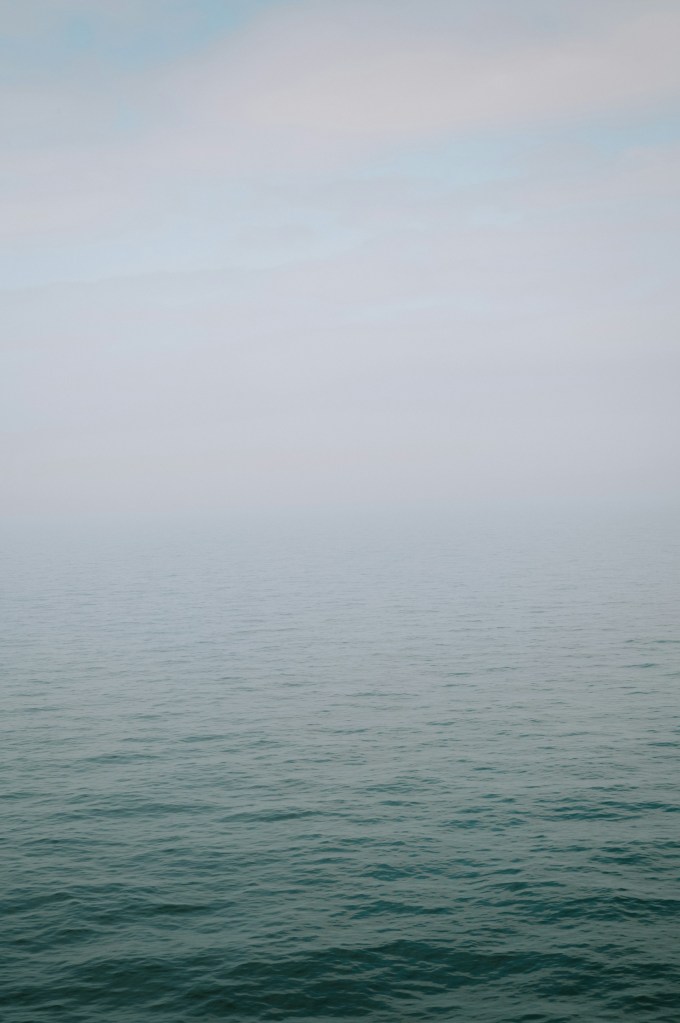
And anyway, I loved the way the world looked without my glasses. At home, the other car-lights bloomed into fuzzy halos of color, floated through the air like magic orbs. On the beach, the line between gray sky and gray-green water disappeared.
No one else was out. I was alone. I imagined I was walking along the edge of the universe.
The first poem in the book was one of my favorites. I knew it by heart, never even pulled the book out of my pocket.
     We are the music makers,
          And we are the dreamers of dreams,
     Wandering by lone sea-breakers,
          And sitting by desolate streams; —
     World-losers and world-forsakers,
          On whom the pale moon gleams:
     Yet we are the movers and shakers
          Of the world for ever, it seems.
Had I already named the ocean Grandfather? I don’t remember. But the ocean held me in thrall. The Atlantic was murky and mysterious. There were currents and crosscurrents. Undertow. As a child, I watched while lifeguards rescued a group of adults stranded on a sandbar some distance from the shore. One woman landed with a big bloody knot on the top of her foot from where the boat had struck her. They all stumbled onto the beach with glazed eyes.
There were also hidden dangers in the waves. Crabs nestled in the sand — which weren’t so bad, they’d just nip at your toes, no big deal. But the jellyfish, with their long purple tendrils — you might not see them, the water was so cloudy. Until you felt that burning hit your legs.
I was going into 9th grade that fall — high school in Wake Forest, population 4,000. The world was on fire, I knew it. But it all seemed so far away: the riots, the protests. Hippies and Haight-Ashbury, drugs and free love.
The crosscurrents inside me were closer and more confusing.
I clung to words like life rafts. Inspirational poems in metered lines that rhymed in predictable patterns. Religious poetry. Hymns.
I was aware that none of this was considered “cool.” So I kept it to myself.
But, out there on the beach alone, there was no need to hide my dreamy mysticism.
I don’t know how long I walked. It was a space with no time. The grainy sand was firm under my feet, but everything else was all gray and misty.
Then the rain stopped. The clouds began to shred like cotton and blow in bits across the sky.
The tide was out. Two dolphins came up to the shore. They swam alongside me for a good long while.
Behind me the sun sliced low through the clouds, came in at an angle as the sun set. The light was golden, a little rosy. The sand up the beach ahead of me was covered with tiny black dots. Tens, maybe hundreds of them. I squinted at them, trying to figure out what they were —
They were snails. Black-shelled snails, sprinkled across that flat brown crust of sand, crawling in almost imperceptible movements toward the shiny edge where the waves still lapped at the shore.
That afternoon I felt like I had touched the hem of eternity, the presence of something that I only knew to call God.
I’m not sure why I’m telling you this story. Except that all the talk about waves and currents in the wake of Tuesday’s election brought to mind a phrase from the poem I carried in my pocket:
     For each age is a dream that is dying,
          Or one that is coming to birth.
Blue waves. And the line between what is dying and what is coming to birth.
I know which side of that line I want to be on.

