In December 1969, Ridgecrest Baptist Church, the church my father had pastored for nine months, voted to dismiss him, 27-11. The night before, buckshot had ripped through the middle of a party in the parsonage, narrowly missing friends of mine, both Black and white. Ridgecrest fired my dad because he refused first to cancel the party, and then refused to resign.
In this excerpt from my memoir, I’ve returned to Wake Forest, North Carolina, to write the story.
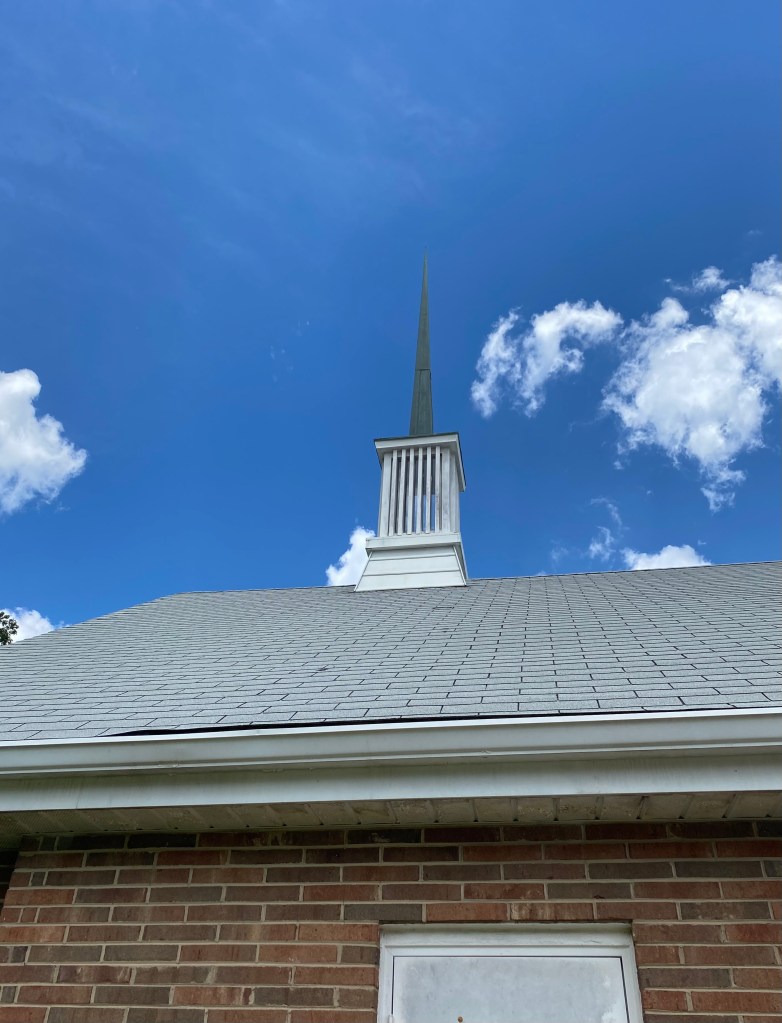
I pull into the parking lot. The gravel crunches beneath my tires as I park the car. Stepping outside, I feel nauseous, and my heart is pounding.
Maybe I should get back into the car and leave—
Instead, I steady myself and walk the short distance to the plain white doors that are the entrance to the church. Ridgecrest Baptist Church. This Sunday marks the first time I have crossed this threshold since 1969.
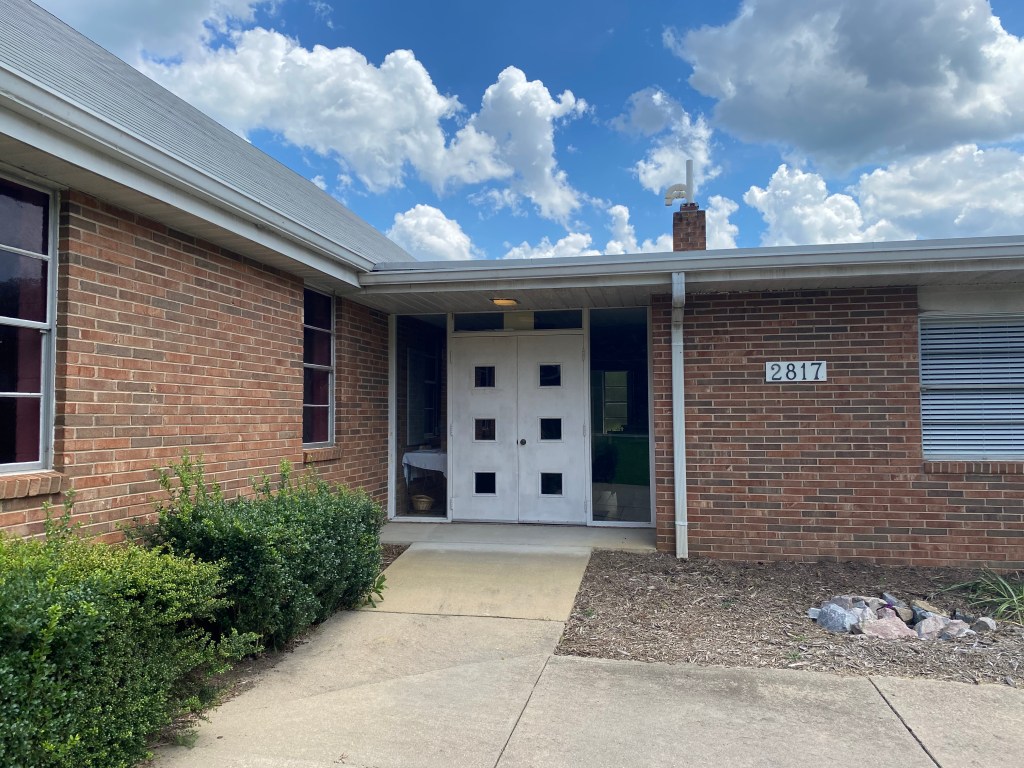
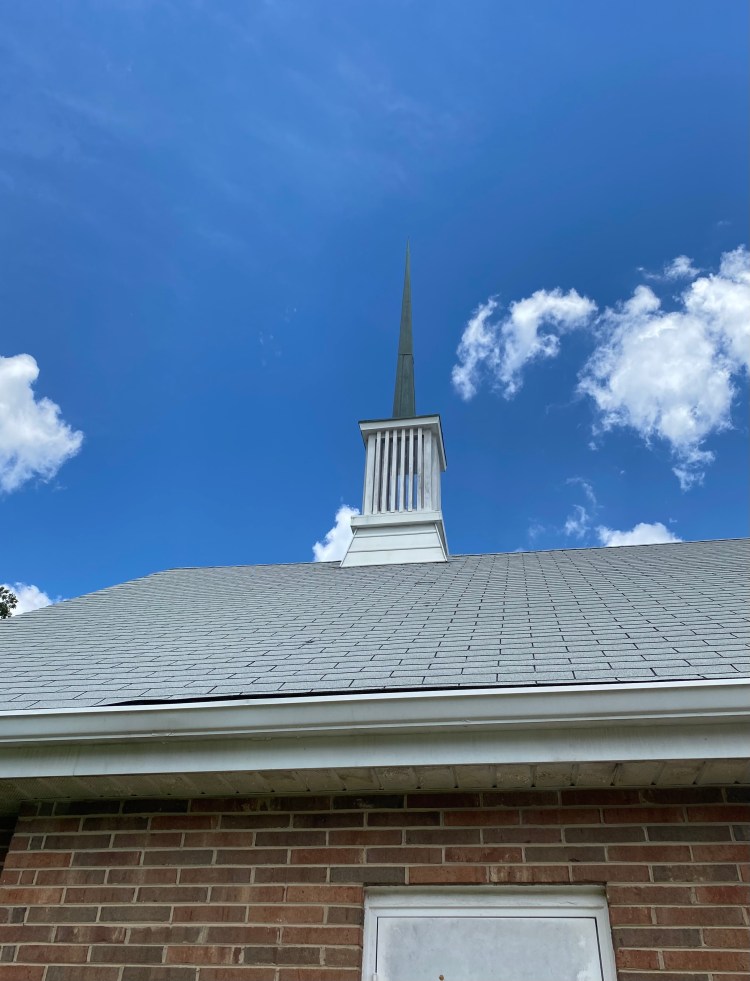
Today is Palm Sunday, 2022. The mid-April sky is cornflower blue with cottony clouds. Easter is late this year, the trees are already bursting with neon green leaves and pale pink blossoms. The dogwoods are in full bloom.
As I reach for the closed door, it opens, throwing me off-balance. A young white man, dressed in a work shirt with rolled up sleeves, smiles his apology, holding the hand of a small white girl with wispy blonde hair. With the other hand, he holds the door open for me. I nod my thanks.
The first thing I notice is that the vestibule is exactly the same. The same white-man portrait of Jesus, with pale skin, light-brown hair, and gray eyes, hangs on the wall outside what I know is the pastor’s study. I turn left to enter the sanctuary.
An usher greets me and hands me a bulletin. My shoe catches on a wrinkle in the carpet, and I stumble. He reaches out to steady me.
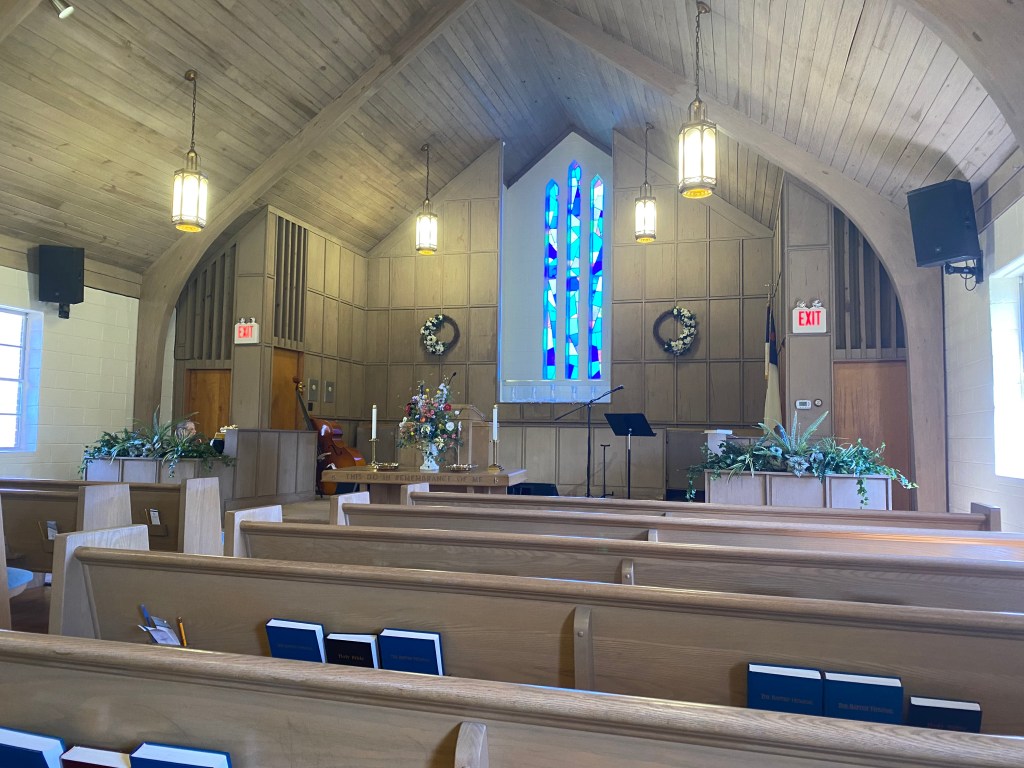
Crossing the threshold into the sanctuary, I slam headlong into the past. Nothing has changed. Not a fucking thing—the same white walls, the same beige pews.
Well, the thick beige carpet under my feet must be new, otherwise it wouldn’t look as good as it does.
But the artificial plants standing in front of the piano and organ on either end of the platform could be the same ones that were here back then. The beige wood panels that line the wall behind the choir loft are eerily familiar. They are adorned with two wreaths, circles of bare, twisted artificial branches with a scattering of artificial leaves and fake white flowers—dead ringers for the wreaths that hung there when Dad was pastor.
Over the baptistry, behind the pulpit, I see three long slivers of stained glass that I remember. Each pane is made up of irregular slices of baby blue and royal blue, pale pink and fuchsia, jumbled together in no discernible pattern. A circle of blue light from those windows framed my father’s head as he stood in the pulpit on our last Sunday.
I settle into a pew on the opposite side of the sanctuary from where I sat with my family in December 1969 and take a photo. As I look around, I see one person who appears to be of Asian descent. Otherwise, the people themselves are beige. Like the carpet. Like the wood paneling.
Like me, I think to myself. To all appearances, I fit in perfectly.
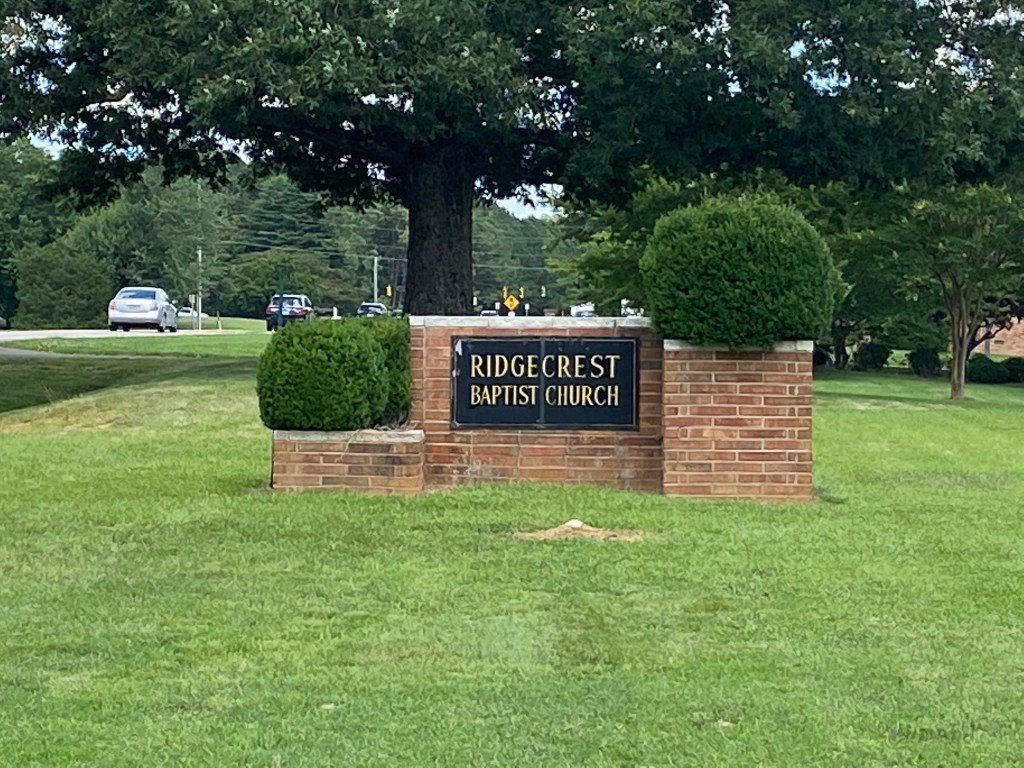
The three main Baptist churches I know of that serve unincorporated Stony Hill, in the area that was once known as the Harricans, are Woodland Baptist Church, Stony Hill Baptist, Church and Ridgecrest Baptist Church.
Woodland Baptist, the oldest, was founded in 1862 while the Civil War was still raging.
Stony Hill Baptist was founded in 1884, almost 20 years after the Confederates surrendered to the Union Army.
Ridgecrest Baptist, the youngest of the three, was established in 1962. Forty-two members of Stony Hill Baptist split off and founded their own church less than a mile away. The split is mentioned in a 1984 booklet commemorating Stony Hill’s centennial, but no reason is given.
As late as 1969, my father told me, the constitution of Stony Hill Baptist stated that “if a n****r steps his foot on our property, we will throw him off.” Whether or not that sentence was struck in later years, I do not know.
Mr. Woodrow Woodlief, chair of deacons when dad was pastor at Ridgecrest, was one of the forty-two. I wish he were still alive so that I could ask him the reason for the split. I would like to think that the word n****r in the church constitution offended their more moderate sensibilities. But, on second thought, that may be too much to hope for.
Back when I was growing up in Southern Baptist churches, Palm Sunday was one of the closest things to a “high holy day” that Baptists had. The church was packed. Everyone received a palm as they entered the sanctuary. The organist played a special Prelude and Postlude. The hymns were jubilant, and the church choirs sang anthems they had spent weeks preparing. People waved their palm fronds, shouting and singing, “Hosanna, hosanna!”
The jubilation continued all week. We returned the following Sunday for Easter, the women wearing brand new outfits, complete with hat, gloves, shiny new shoes, and matching purse.
There was a brief pause on Good Friday to acknowledge Jesus’ betrayal and crucifixion. But, in effect, we celebrated Easter all week. It was what my dad later called “bootleggin’ in the Resurrection”–a curious image when you consider that one of the economic mainstays out in the Harricans was the manufacture of moonshine.
At Ridgecrest on this Palm Sunday, the congregation is sparse. There is no hosanna hoopla, no choirs or handbells, no organist, no wild jubilation. Instead, the earnest young blond preacher takes us through the steps to salvation.
The theology is all too familiar to me: Man—inclusive language has not yet found its way to Ridgecrest—can be saved from the fires of eternal damnation only by the blood of Jesus, shed in atonement for our sins on Calvary’s tree. His primary concern, once he has been saved, is to win others to Christ. And those who refuse to accept salvation through Jesus will die in sin and suffer everlasting torment in the unquenchable fires of Hell.
I could recite the well-worn phrases, word for word, in my sleep. The language collapses in on me, threatens to smother me. There is good reason why I am no longer much of a churchgoer.
Where is the itinerant preacher who told his followers that everything depends on loving God with all your heart and loving your neighbor as you love yourself. Where is the Jesus who loved outcasts, who blessed the people that polite society turned their backs on. Where is the angry Jewish rabbi who overturned tables in the Temple and drove out the merchants with a whip of cords that he made himself—and all of this, the week before he was publicly executed by the Roman Empire. Why is there no mention of a world that is this very moment being ripped apart by hatred and intolerance, why no word about the hell on earth of war, racism, poverty, white supremacy, why no reference to the daily implosions of dreams too long deferred—
Hell, yes, I’m angry!
I shake the earnest young preacher’s hand on my way out. We chat for a short minute. I do not tell him of my history with Ridgecrest, although I do fill out a visitor’s card with my full name, Karen Bryant Shipp. When I email him during the following week and ask to meet with him, he never replies.
I drive out of the parking lot. I see someone walking into the house that used to belong to one of the Ridgecrest deacons who gave my father an ultimatum, but that man must be long dead.
The two-lane highway that leads back to the town of Wake Forest is lined with new housing developments. I remember gently rolling fields of tall grasses, golden in the late afternoon sun as I rode home from school, the hills dotted here and there with sometimes abandoned farmhouses.
Now, there are clusters—can I even call them neighborhoods?—of oversized residences with tiny lawns. The houses huddle behind manicured hedges and black iron railings.
The highway itself has changed. I remember a country road coiling around old homesteads.
Now, it is a streamlined and straightened highway, level for as far as I can see. The twists and turns lie buried deep under the reservoir formed when they dammed the Neuse River. A fragment of the old road has been turned into a hiking trail. Here and there, under gravel, you can still see the pavement. Its fading yellow and white center lines lead to where the road disappears beneath the muddy waters of Falls Lake.
Much has changed. Why is Ridgecrest still the same? Does the congregation have no desire to move beyond the narrow confines of the community it serves?
Today, though, what used to be a narrow and insulated community is rapidly changing. And I imagine there is more than one developer who would like to get their hands on the prime real estate the church building occupies and turn it into profit.
The ground that Ridgecrest Baptist Church inhabits is shifting under their feet, while they cling to a dead theology that will no longer serve. Well beyond the reach of resurrection.

