Fifty-two years is a lot of unfinished business.
This post is drawn from parts of my memoir, From Where I Stand, a story of love that crosses time and race.
In this excerpt, William Lucas and I meet again for the first time in five decades.
William and I plan to meet on April 1, 2022.
April Fools’ Day.
I laugh to myself. I wonder if he’ll show up. From what others have told me, I have good reason to wonder.
It is eight months since Bettie’s cookout, a little less since I received the text from William. He and I have been communicating erratically by text. Neither of us likes talking on cell phones.
Wake Forest is as beautiful in the spring as I remember. Along North Main Street, the redbuds and dogwoods break out into blossoms of purple and white. The branches of taller trees are traced in light green. New grass is pushing its way through the leftover stubble of winter.
When April 1st arrives, I am staying again with my white friends in town. As the crow flies, William’s house is close to theirs, but what should be a straight shot is a maze of twists and turns.
Railroad tracks separate what used to be, and to some extent still is, the Black neighborhood from the white one. Streets used to cross over the tracks, but they’ve been cut off, turned into dead ends. So, instead of driving south for a couple of blocks and turning left onto William’s street, I have to turn north, then turn right onto a street which connects me with another street, which winds into yet another street, which finally gets me across the tracks. I turn right and drive south for a quarter of a mile before I turn left onto William’s street.
There’s a church up ahead, to the right. Olive Branch Baptist Church was founded in 1865 by formerly enslaved Black people. The steeple is clearly visible on the other side of the tracks, but when I was living in Wake Forest as a teenager, I never remember seeing it.
Just past the church is a small park. William’s house, the home where he grew up, is across from the park. It is the house where both of his parents and his significant other died—a house he tells me later he had begun to think of as a “death house.” The porch is shrouded with old shower curtains and frayed wicker shades.
I pull into his driveway, an unpaved patch of red clay. In my rear-view mirror, I see a man loping toward my car from across the street. It’s William.
He motions to me. “Come to the park,” he shouts.
I back out of his driveway and look for another place to park my car, ending up in the Olive Branch parking lot.
Why didn’t I stay where I was and cross over the street on foot.
My heart is beating. Fast.
One of my white friends told me that in college, William was heavily into the Black Power movement. Edgy, aloof, he called himself the Mad Black Poet, and he didn’t hang with white people much.
I am not sure what to expect.
I get out of the car and cross the parking lot to meet William as he moves toward me.
He is taller than I remember and heftier, but I still recognize the cool gait, the cool slump to his shoulders. He still holds his arms slightly away from his body as if getting ready to intercept a pass. He wears a blue surgical mask—we are in year two of the COVID-19 pandemic—and I hastily pull up my black KN95.
“Do you hug?” I ask.
He pauses, says nothing, then opens his arms into an wide wingspan. The hug is awkward, a bit stiff—friendly, but formal, like my memory of our first, and only, dance in high school. In my journal later that night, I write, “His hug enveloped me.”
We move to a bright green metal picnic table under a shelter and sit on the same side, half in, half out of the sun. The air is still a bit chilly, too cold to take off my coat.
William is wearing a blue-green fleece pullover. A string of smooth wooden beads hangs around his neck, with an electric-blue pendant of blown glass. His camouflage bucket hat is pinned back at the brim with a small angel, the kind organizations send you in the mail when they want a donation. His white-grey beard curls out from under and around the sides of his mask.
“Since we’re outside, is it OK with you if we take our masks off?” I ask.
His eyes are darker than I remember. And his gaze is more present. He has shaved his upper lip, and his skin, the color of milk chocolate, is smooth. His full lips open to reveal well-worn teeth, and his face crinkles into a smile that is much friendlier than his hug.
I never ever remember seeing him smile, I think.
As we talk, his eyes flare open. The words pour out in a torrent, and gestures punctuate every phrase. His hands are even more beautiful and expressive than I had remembered.
I ask him to tell me what he remembers about the party and about the desegregation of Wake County schools. But I avoid the temptation to direct the conversation. To tell the truth, I’m enjoying just being with him.
We chat about this and that. Personal history, mostly. Our early marriages, both of which ended in divorce. His experience in college, graduating as the first Black male Physical Therapist from University of North Carolina, Chapel Hill. His move to Florida, then back home to Wake Forest to look after his parents. My college studies in music, graduating from Eastern Kentucky University and University of Kentucky. My move to New York to be an opera singer, then to Georgia to work as minister of music for a Baptist church. His father’s dementia. My mother’s Alzheimer’s.
He tells me his father died in 2009, and his mother, just before the pandemic hit. My mother died in 2016. At the time, my father is still alive. I note that William mentions the woman he was with for 30 years only in passing.
A few months later, he confesses to me that his heart was pounding like mine. He tells me that he never forgot me after all those years, that he always felt we had “unfinished business.” His words.
We talk for three hours.
Fifty-two years is a lot of unfinished business. We barely break the surface.
We meet again eight days later, on April 9.
Bettie said to me, “A sighting of Tubby” –what childhood friends call him– “is as rare as the sighting of a unicorn.” So, I nickname him Unicorn. When I tell him why, he laughs and dubs me Super K.
We sit at the same picnic table as before in the park across from his house. In one week, the weather has turned bitterly cold, more like February than early April. I am wearing my winter coat, and still I’m shivering. The sky is overcast, and the dampness doesn’t help.
Why doesn’t he invite me into his house?
I assume it’s because he is so private—even reclusive, as Bettie and the others told me.
Months later, he tells me that he thought I didn’t want to come into his house. He thought that, as a white woman, maybe I was afraid of being alone with him.
William lays a cloth bag on the table between us. Smiling, he pulls out a framed studio portrait of his parents. I realize with shock that, even after all we went through in 1969 and 1970, I never met them.
He shows me a polaroid of his father in a wheelchair. Next to the chair is the woman who was William’s partner. Neither his father nor his partner look into the camera. Again, William says next to nothing about her.
He pulls out a photo of himself as a young boy, cut from a larger picture.
“What age are you here?”
“I don’t know…6…5….”
The boy is dressed in a heavy winter coat, plaid, and a matching hat with ear flaps. His eyes—those eyes, he had them even then!—are looking up and to the side. The corners of his lips lift into a mischievous half-smile. Utterly and devastatingly adorable.
William hands me a book with the ironic title, Divine Justice. Tucked inside is a booklet of inspirational stories and a card.
The book is a gift. But the real gift is just inside the cover: drawings, collage, and aphorisms addressed to me.
A sticker reads “May God Bless You,” and beneath it, a note:
KAREN [AKA "SUPER K"]
LIVE WELL, BE KIND TO OTHERS,
AND BE THE BEST ITERATION OF
YOURSELF! ALWAYS YOUR FRIEND,
William
ALWAYS YOUR FRIEND. My heart catches. I’m afraid to give it too much importance.
I’ve brought a gift, too: a wooden bowl that a mutual friend carved from a chunk of local dogwood. The bowl feels much less personal than his gift. But then, I am afraid to get too personal too soon. I don’t want to scare him away.
William and I talk about high school and college and working. We chat about anything but the party—even though talking about the party and what he remembers about the shooting is the reason I gave for wanting to meet him. But I don’t mind. I’m happy to be sitting there with him, talking about whatever comes up.
We share stories, just like we did on April Fools’ Day. At the end of three hours, the sun is sinking behind Olive Branch and the Wake Forest Cemetery that sits next to it.
I am so cold, my fingers are numb. And the friends I’m staying with across the tracks are expecting me for dinner. It’s time to go.
As I stand, William reaches once more into his bag and pulls out one last gift: a six-inch statuette of an angel playing the violin. She is Black, dressed in a white robe trimmed in gold.
He hands her to me and says, “I hope that you think of me every time you look at her.”
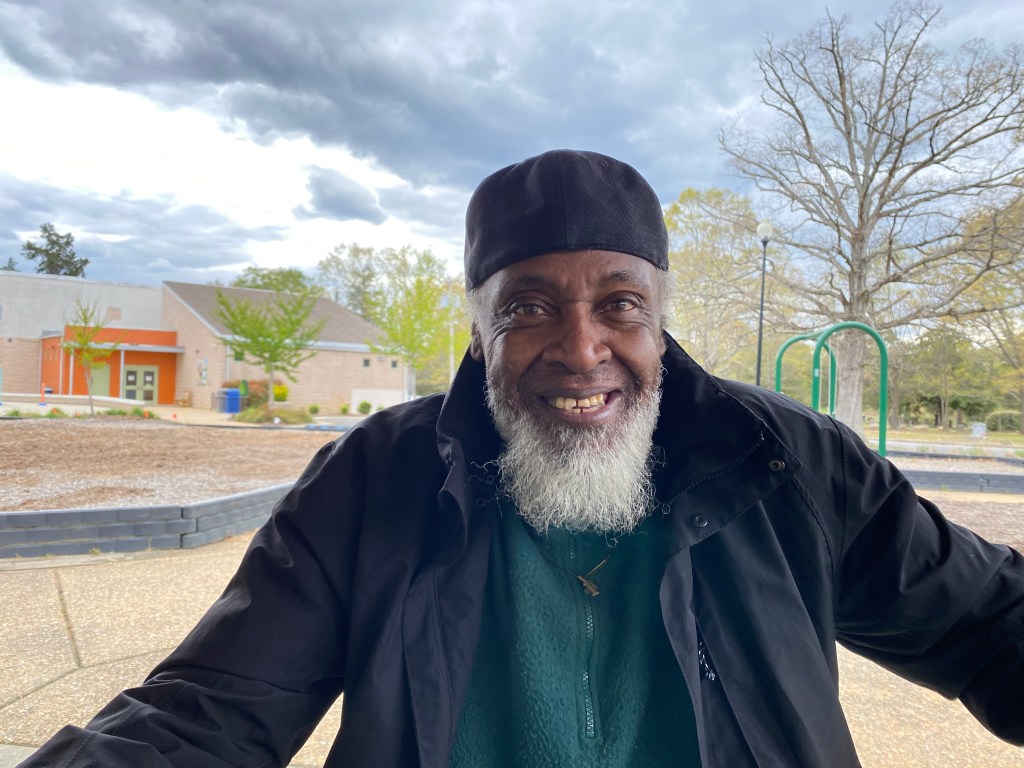
“Can I take a photo of you?” I blurt out. He has already told me he doesn’t like to have his picture taken, so it’s a long shot. But he agrees.
The day is dimming. The shelter casts shadows over his face. I wish we could move to better light, but, afraid to push my luck, I snap quickly. And only once.
I needn’t have worried about the lighting. In the photo, his face is radiant, his gaze direct and engaging. His mouth breaks open into a broad, relaxed smile.
The following Friday—Good Friday, April 15, 2022—I talk to my father for the last time. We are on a video call, I, in Wake Forest, and he, at the assisted living facility in New Jersey where he has been living since 2020.
He looks thin, thinner than I ever remember seeing him. But his smile is as broad as ever.
I tell him I am staying with Bob and Liz Ford, old family friends. And in fact, I am sitting in the room that was my bedroom in their house for the five months after the shooting.
Dad launches into reminiscences about our last months in Wake Forest. “You know, that was something else, when they offered us a place to live. They coulda gotten themselves into a whole lotta trouble.”
“Guess who I saw?” I say. “William Lucas.”
“William Lucas!” His eyes light up at William’s name. “How is he doing?”
He talks about how much he liked William. He recalls that there was a Black pastor named William Lucas in Smithfield, North Carolina. “Can you believe that. The same exact name!”
At the end of the call, he leans into the screen.
“You know what? You’re looking good,” he says.
“Well, thanks, Dad.”
“No, I mean it! You’re looking pretty sharp!”
I am unaware that this will be my last conversation with him.
When I return to Georgia, I show the photo I took of William to a friend.
Her response is immediate.
“He’s in love with you,” she says.
“What?!”
“That man is in love with you.”
 holy discomfort: Love letters from a reluctant Christian